
Named stone
Glass Buttes obsidian
Also called Glass Butte obsidian, Glass Buttes Source Complex
A kind of obsidian
Glass Buttes obsidianObsidianWest Coast & Plateau3 photos
Description
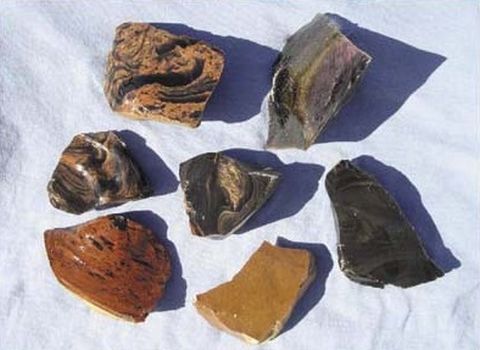
Glass Buttes, in Lake County in south-central Oregon beside U.S. 20 between Bend and Burns, is one of the largest obsidian sources in Oregon. A rhyolite volcanic center about 5 million years old, it holds obsidian across roughly 746 square kilometers as float pebbles and cobbles and in subsurface veins, in nine geochemical varieties. People have taken high-quality obsidian here for at least 14,000 years, and Clovis artifacts of Glass Buttes obsidian are known from Oregon to the Willamette Valley. Its glass travelled as far as southwest British Columbia. The Nevada Department of Transportation notes gem-quality glass in red, brown, burgundy, mottled gray, clear and black. The buttes are also a rockhound destination and are managed by the Bureau of Land Management.
How to identify it
- Colour
- Red, brown, burgundy, mottled gray, clear and black, with variations (Moore). Stueber and Skinner call it colourful and high quality.
- Texture
- Some pieces approach glass in clarity; occurs in small pieces and massive chunks, varying by locality (Moore).
Geology
A large rhyolitic volcanic center about 5 million years old in the High Lava Plains, with obsidian as surface float pebbles and cobbles and as primary subsurface veins over about 746 km2. Nine geochemical varieties are recognised. Mercury and geothermal exploration have also taken place.
Where it comes from
West Coast & Plateau
States
Quarries and outcrops
- Glass Buttes, Lake County (also Crook, Deschutes and Harney counties for some varieties), along U.S. Route 20 between Bend and Burns
- Little Glass Butte and Glass Butte (1,945 m)
- BLM Prineville District land
Used by
- Clovis: 39 Clovis artifacts of Glass Buttes obsidian identified, including the Dietz site
- Western Stemmed (contemporary with Clovis)
- Archaic: Cascade, Humboldt, Elko and Rose Spring series points in the 1975 survey collection
- Northern Paiute territory: used for thousands of years
Look-alikes
Stones that are easy to confuse with Glass Buttes obsidian.
- Other Oregon obsidians with chemical types in the same area (13 sources within a 50 km radius)
- Obsidian Cliffs and Newberry obsidians (from the Cascades and Newberry Volcano)
Sources
- Ozbun, Terry L., and Ron L. Adams, eds. 2015. Toolstone Geography of the Pacific Northwest. Archaeology Press, Simon Fraser University. Chapter 12: Stueber, Daniel O., and Craig E. Skinner. Glass Buttes, Oregon: 14,000 Years of Continuous Use.archpress.lib.sfu.ca (opens in a new tab)
- Moore, Joe. 2009. Great Basin Tool-Stone Sources: The NDOT Obsidian and Tool-Stone Sourcing Project, 2002 Progress Report. Nevada Department of Transportation, Cultural Resource Section.deschutesmeridian.com (opens in a new tab)