
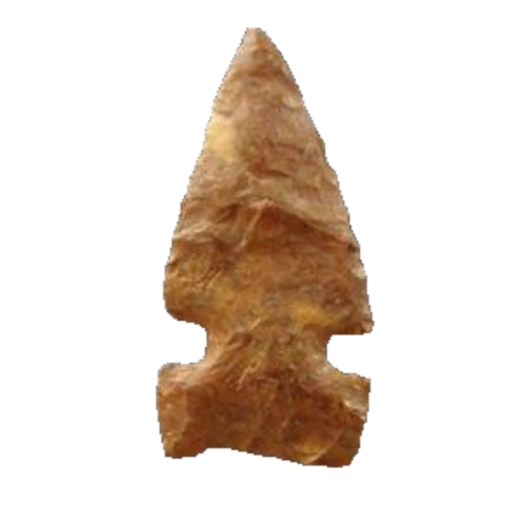
Arrowhead type
Cut Bank Point
Cut BankPlains Side Notch Cluster600 - 200 B.P.Classic to HistoricKey facts
- Age
- 600 - 200 B.P.
- Cultural period
- Classic to Historic
- Size
- Small
- Shape
- Side Notch
- Glacial period
- Little Ice Age
More from the Preclassic and Classic, Historic periods
Description
This slender, compact side-notched projectile point exhibits a flattened profile, with a blade that is predominantly straight, although it may exhibit a subtle curvature. The U-shaped notches, oriented in a parallel configuration, create a distinctive horizontal shoulder and an expanded stem, with the notch width increasing towards the base and tapering as it approaches the blade. The basal margin is characterized by a slight concavity, while the basal edges converge from the notch to the base, forming rounded corners. The overall craftsmanship of this point is of high quality, featuring a complex flaking pattern that ranges from oblique parallel to random, indicative of a skilled manufacturing technique.
Size
The dimensions of the arrowheads are characterized by a length range of 10 to 34 millimeters, with a mean length of 20.6 millimeters. In terms of width, the measurements span from 9 to 18 millimeters, averaging 14.2 millimeters. The thickness of the arrowheads varies between 2 and 7 millimeters, with a mean thickness of 2.6 millimeters.
Distribution
This type is mainly discovered in the upper grasslands area of Montana, South Dakota, North Dakota, extending into eastern Colorado, northern Nebraska, and reaching southern Saskatchewan and Alberta
Mainly found in
Also found, less often, in
Additional information
In the realm of Native American arrowheads, a distinctive type stands out due to its unique notch configuration. Characterized by a notch that tapers to a narrower width at the blade compared to its wider portion further within the notch, this type has been extensively documented. Noted archaeologist Thomas F. Kehoe provided a comprehensive illustration of this type in 1966, shedding light on its various subtypes.
These subtypes, collectively referred to as Plains Side Notch variants, encompass a range of specific classifications. The primary type, dubbed Plains Side Notch, serves as the foundation for understanding the subsequent variants. These include the Billings, Buffalo Gap, Cut Bank, Emigrant, Paskapoo, Pekisko, and Washita types, each possessing subtle differences that set them apart from one another. By examining these variants, researchers can gain valuable insights into the technological and cultural developments of the Native American groups that crafted these arrowheads.
The meticulous documentation of these Plains Side Notch variants underscores the complexity and diversity of Native American arrowhead production. The fact that these types have been identified and categorized highlights the significance of archaeological research in uncovering the nuances of prehistoric cultures. Through the study of these arrowheads, scholars can reconstruct the lives and traditions of the people who created them, ultimately enriching our understanding of the rich cultural heritage of Native American communities. By exploring the characteristics and variations of these arrowheads, researchers can continue to refine their knowledge of the historical context in which they were made and used.
Identified by
- Named by
- Thomas Kehoe
- Year
- 1966
- Type site
- (click
Similar types
Types that are easy to confuse with the Cut Bank point.
- Buffalo Gap
- Cayley
- Cluny
- Emigrant
- Lookingbill
- Mortlach
- Pekisko
- Washita
Other types in the Plains Side Notch Cluster
- Billings
- Paskapoo