
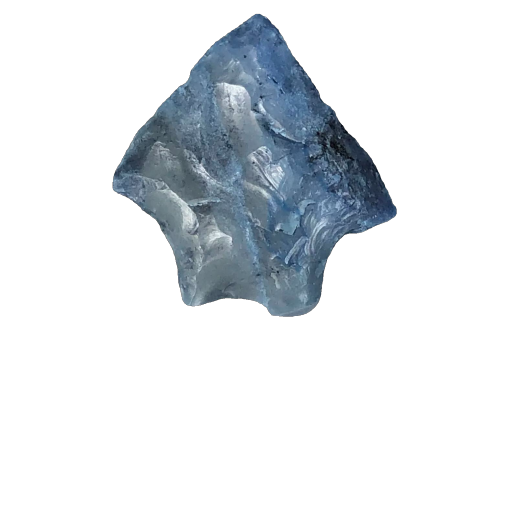
Arrowhead type
Arredondo Point
ArredondoArchaic Stemmed Cluster7,500 - 5,000 B.P.Middle Archaic18 reference photos
Key facts
- Age
- 7,500 - 5,000 B.P.
- Cultural period
- Middle Archaic
- Size
- Medium to Large
- Shape
- Straight Stem to Contracting Stem to Bifurcated
- Material
- Coral
- Glacial period
- Middle Holocene
More from the Archaic period
Description
This stemmed point exhibits a robust profile, measuring between 1.75 and 4.75 inches in length, with a cross-sectional shape that is distinctly elliptical. The blade's curvature can vary, ranging from a pronounced excurvate shape to a straight edge. The shoulders of the point are typically subdued and angled upward, although they can also be oriented horizontally. The stem is characterized by its breadth and can be either straight or slightly flared. The base of the point is relatively short and displays variability in its shape, spanning from concave to bifurcated. Furthermore, the tangs at the base can be rounded or sharp. The flaking pattern observed on this point is random, lacking a consistent or organized arrangement.
Size
The arrowhead's dimensions are characterized by the following measurements: its overall length ranges from 44 to 120 mm, with a typical average length of 55 to 65 mm. The stem's length is between 11 and 20 mm. The blade's width spans 35 to 55 mm, averaging 40 to 45 mm. In contrast, the stem's width varies from 17 to 35 mm, with average widths of 25 mm at the shoulders and 22 mm at the base. The basal concavity is observed to be between 3 to 6 mm, while the overall thickness of the arrowhead is measured at 9 to 15 mm. Additionally, the basal concavity is further specified to range from 4 to 7 mm.
Distribution
This type is mainly located from central southern Florida, extending into southern portions of Georgia and the southeastern region of Alabama
Also found, less often, in
Additional information
The age of this particular arrowhead point remains uncertain, as it has not been discovered in a context that has been radiocarbon dated. Nevertheless, its stratigraphic position at various sites provides valuable clues about its temporal placement. Notably, this point has been found beneath ceramic levels and above Suwannee points, suggesting an age range of approximately 10,000 to 4,000 years before present. This chronological bracket is further refined by the work of Farr (2006), who assigns this point to the Early Archaic period based on its distinctive bifurcated base, a characteristic more commonly associated with this time frame.
The classification of this point is not without debate, however. Granger and Granger (2013) propose a Middle to Late Archaic period attribution, drawing parallels with similar points such as the Pinto, Hanna, Duncan, and McKean points. Additionally, the loose association of this point with Hamilton points raises the possibility of a temporal placement between the Early and Middle Archaic periods. Bullen's research highlights similarities between this point and the Pedernales point of Texas, leading him to assign it to the Late Archaic period. Whatley (2002) acknowledges the discrepancies in dating but concurs with Bullen's assessment, while also suggesting that a Middle Archaic period attribution could resolve the enigma of the missing Archaic point in the Georgia Coastal Plains.
A closer examination of the point's morphology reveals characteristics that distinguish it from other types, such as the Hamilton point. According to Bullen (1975), the Arredondo point is marked by a weaker shoulder, a deeper basal concavity, and greater thickness. While some researchers argue that the difference between the two types hinges solely on the depth of the basal concavity, a more nuanced understanding of these characteristics is necessary to accurately classify and date these points. By considering the collective insights of these scholars, we can gain a deeper understanding of the cultural and chronological context of this enigmatic arrowhead point, ultimately shedding light on the lives and traditions of the Native American communities that crafted it.
Identified by
- Named by
- Ripley P. Bullen
- Year
- 1968
Similar types
Types that are easy to confuse with the Arredondo point.
- Hamilton
- Kirk
- Notchaway
- Savannah River
- Seminole
- Wacissa