
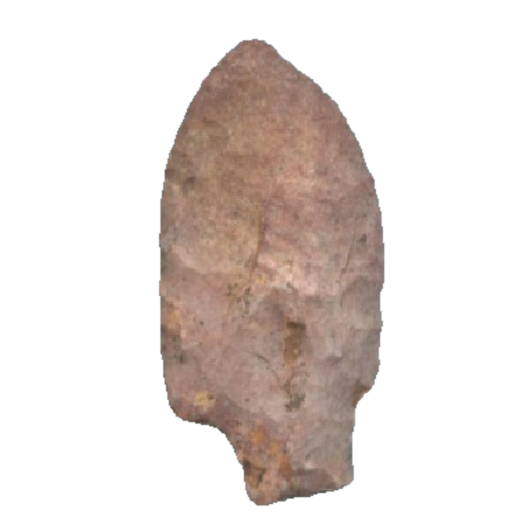
Arrowhead type
Sumter Point
SumterArchaic Stemmed Cluster8,000 - 7,000 B.P.Middle Archaic9 reference photos
Key facts
- Age
- 8,000 - 7,000 B.P.
- Cultural period
- Middle Archaic
- Size
- Medium to Large
- Shape
- Contracting Stem to Straight Stem
- Material
- Chert
- Glacial period
- Middle Holocene
More from the Archaic period
Description
This medium-sized, ovate point features a stemmed morphology with a contracting profile, accompanied by an elliptical cross-sectional shape. The blade exhibits a predominantly excurvate curvature, imparting an ovoid silhouette. Following re-sharpening, the blade may assume a more linear orientation, occasionally displaying fine serrations resulting from the application of pressure flaking. The shoulders are typically subdued and inclined upward, often exhibiting asymmetry, with one shoulder being less pronounced or even absent. The stem is characterized by its short, stubby proportions and square outline, which can range from straight to slightly tapering. The base of the point is generally straight, while the flaking pattern appears to be random, lacking a discernible order or arrangement.
Size
The dimensions of the arrowheads are characterized by the following measurements: overall length ranges from 45 to 90 mm, with a mean length of 52 to 57 mm. The stem length varies between 8 to 13 mm, averaging 12 mm. The width of the arrowhead spans 31 to 60 mm, with an average width of 35 to 45 mm. At the shoulders, the stem width is between 19 to 21 mm, while at the base, it narrows to 15 to 19 mm. The thickness of the arrowhead is measured between 8 to 11 mm, as reported by Bullen (1976) and Whatley (2002).
Distribution
This type is mainly discovered in the Tampa area and throughout middle Florida.
Mainly found in
Additional information
In his 2006 publication, Farr observes that Sumter points are a relatively rare type of arrowhead. The name "Sumter" was coined by Bullen, who drew inspiration from Sumter County, although intriguingly, his Type Collection does not feature any Sumter points actually originating from that county. Characteristically, Sumter points exhibit a distinctive combination of features, including weak, rounded shoulders, straight bases, and short, broad stems that taper to some extent. As Bullen noted in 1975, despite being fairly well-crafted, these points often possess a coarse or massive appearance.
A notable aspect of Sumter points is their similarity to Arredondo points, with the primary distinguishing feature being the removal of a few basal thinning flakes. Initially, Bullen described Sumter points as having broad, square stems, but subsequent research has expanded the type definition to include points with short, narrow, contracting stems, akin to those found on Thonotosassa points, albeit on a smaller scale. This refinement in classification highlights the complexities of arrowhead typology and the potential for overlap between different point styles.
It is also worth noting that many purported Sumter points may, in fact, be re-sharpened Thonotosassa points that have been reduced in size, as pointed out by William Lunsford. This observation underscores the importance of careful analysis and consideration of the manufacturing and use histories of these artifacts. By examining the morphological characteristics and potential re-sharpening patterns of Sumter points, researchers can gain a deeper understanding of the technological and cultural contexts in which they were created and used.
Identified by
- Named by
- Lyman O. Warren and Ripley P. Bullen
- Year
- 1966
- Type site
- The Fletcher Davis Site (8HI106), Hillsborough County. Florida
Similar types
Types that are easy to confuse with the Sumter point.
Other types in the Archaic Stemmed Cluster
- Hamilton
- Levy
- Marion
- Putnam
- Thonotosassa