
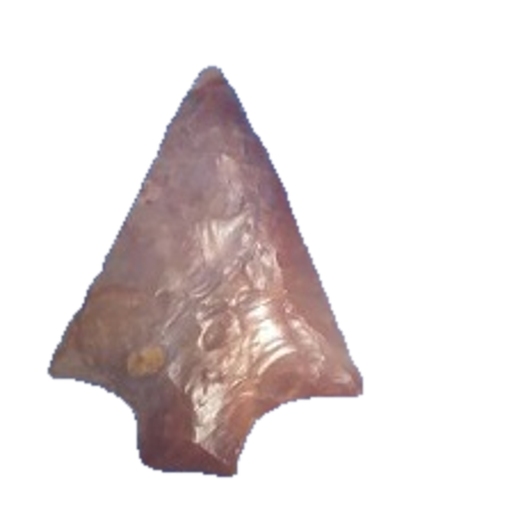
Arrowhead type
Hardee Beveled Point
Hardee BeveledArchaic Stemmed Cluster8,000 - 5,000 B.P.Middle Archaic23 reference photos
Key facts
- Age
- 8,000 - 5,000 B.P.
- Cultural period
- Middle Archaic
- Size
- Small to Medium
- Shape
- Contracting Stem
- Material
- Coral
- Glacial period
- Middle Holocene
More from the Archaic period
Description
This stemmed point exhibits a compact, rhomboid cross-sectional profile, measuring between 1 to 3 inches in length. The blade's morphology is predominantly straight, although some specimens may display a subtle excurvate curvature, while re-sharpened examples can exhibit an incurvate to recurvate profile. A distinctive characteristic of this point is the presence of right-side beveling on the blade, resulting from re-sharpening processes. In contrast, unmodified examples, referred to as Hardee Plain, lack beveling altogether. The shoulders of this point can vary in orientation, ranging from horizontal to upwardly angled. The stem's shape is versatile, spanning from straight to slightly contracting. The basal edge is typically straight, but can also be slightly convex or concave. The flaking pattern on this point is characterized by coarse, broad percussion flaking, juxtaposed with finer pressure flaking along the right edge, creating a distinctive texture and visual appeal.
Size
The dimensions of the arrowheads are as follows: they typically range from 25 to 80 mm in overall length, with a common range of 50 to 60 mm. The stem measures between 10 to 15 mm in length, while the blade width spans from 25 to 40 mm. The width of the stem itself ranges from 15 to 22 mm, and the thickness of the arrowhead varies from 5 to 10 mm.
Distribution
The Type I (Hardee Beveled) predominantly occurs between Marion County and the Withlacoochee River. The Type II (Gibson) exhibits the greatest abundance in the Tampa area and adjacent territories.
Mainly found in
Additional information
In his 1975 study, James Gray distinguished a secondary variant of arrowhead, which he termed the Gibson Serrated type, also referred to as Hardee Type II. This classification was derived from the collection of Jim Gibson, whose artifacts exhibited distinctive characteristics. Notably, the Gibson Serrated type is marked by its slender profile and meticulous craftsmanship, featuring fine serrations along the blade's edge. Additionally, these points display right-side beveling, a trait that contributes to their unique identification. Observations by Lloyd Schroder, as recorded in 2012 (W18), further highlight the angular and broad shoulders that tend to be more pronounced in this variant, setting it apart from other types of arrowheads.
The Gibson Serrated type's refined features and specific attributes underscore the complexity and diversity of Native American arrowhead craftsmanship. The presence of fine serrations, in particular, suggests a high degree of skill and attention to detail, as these subtle markings would have required careful execution to achieve. Moreover, the right-side beveling and angular shoulders of the Gibson Serrated type demonstrate a deliberate design choice, potentially reflecting the cultural and functional preferences of the communities that created these artifacts.
The study of the Gibson Serrated type, as facilitated by the work of James Gray and Lloyd Schroder, among others, contributes significantly to our understanding of the technological and artistic developments in Native American arrowhead production. By examining the specific characteristics of this variant, researchers can gain insights into the cultural exchange, technological innovation, and adaptive strategies that shaped the lives of Native American communities, ultimately enriching our appreciation for the history and heritage of these societies.
Identified by
- Named by
- Ripley P. Bullen
- Year
- 1968
Similar types
Types that are easy to confuse with the Hardee Beveled point.
Other types in the Archaic Stemmed Cluster
- Gibson