
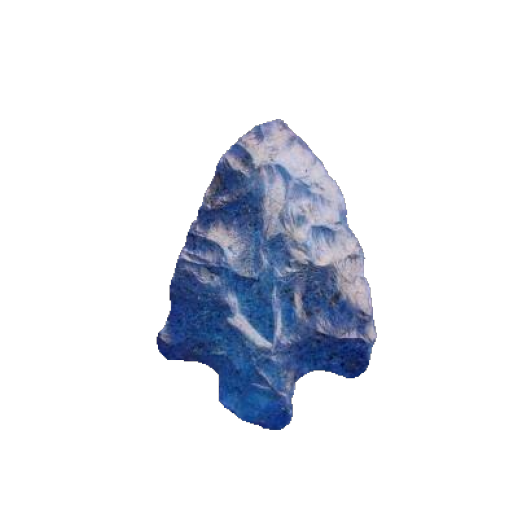
Arrowhead type
Alachua Point
AlachuaArchaic Stemmed Cluster6,000 - 3,500 B.P.Middle Archaic14 reference photos
Key facts
- Age
- 6,000 - 3,500 B.P.
- Cultural period
- Middle Archaic
- Size
- Medium to Large
- Shape
- Straight Stem
- Glacial period
- Middle Holocene to Neoglacial
More from the Archaic period
Description
This triangular stemmed point exhibits a robust profile, measuring between 2 to 4.5 inches in length, with a cross-sectional shape that is elliptical in outline. The blade edge displays a range of curvature, from straight to distinctly excurvate. Characteristically, the shoulders are broad and oriented horizontally, although some specimens may exhibit a subtle upward inclination. The transition between the shoulder and stem is typically smoothed by a rounded junction. The stem itself is generally straight, but may exhibit a slight contraction. The basal edge is predominantly straight, yet can vary subtly, ranging from a slight convexity to a faint concavity. The flaking pattern on this point is randomized, resulting from a combination of percussion flaking and pressure flaking techniques applied along the edges.
Size
The dimensions of the arrowheads are as follows: overall length ranges from 40 to 102 mm, with a typical average length of 50 to 65 mm. The stem measures between 10 to 18 mm in length. The blade width varies from 30 to 60 mm, averaging between 40 to 45 mm. In terms of stem width, the measurements fall within the 15 to 25 mm range. The thickness of the arrowheads is recorded between 5 to 13 mm.
Distribution
This type is mainly discovered in North Florida and stretches into Southwest Georgia and Southeast Alabama, The extent to which these specimens reach central to southern Florida remains unresolved
Also found, less often, in
Additional information
In the realm of Native American arrowheads, the Florida Archaic Stemmed type holds significant importance, with a rich history of classification and subtyping. Initially, this type was designated as the Florida Archaic Stemmed, and subsequent research by Bullen led to the identification of four distinct subtypes: Alachua, Levy, Marion, and Putman, as noted by Farr in 2006. A notable characteristic of these subtypes is their temporal distribution, with the Putman subtype being the earliest, distinguished by its contracting stem and convex base.
The remaining three subtypes - Alachua, Levy, and Marion - are considered to be of similar age, with their variations primarily stemming from differences in stem morphology. This subtle distinction has led researchers, such as Granger and Granger in 2013, to categorize them as variants of the same overarching type, rather than entirely separate entities. This nuanced understanding underscores the complexity and diversity within the Florida Archaic Stemmed type, highlighting the importance of meticulous analysis in archaeological classification.
The identification and study of these subtypes not only shed light on the technological and cultural developments of Native American communities but also demonstrate the value of ongoing research and refinement in archaeological taxonomy. By examining the characteristics and variations within the Florida Archaic Stemmed type, researchers can gain a deeper understanding of the historical context and cultural significance of these artifacts, ultimately contributing to a more comprehensive narrative of Native American history and material culture.
Identified by
- Named by
- Ripley P. Bullen and Edward M. Dolan
- Year
- 1959
- Type site
- The Johnson Lake Site, Marion County, Florida
Similar types
Types that are easy to confuse with the Alachua point.
- Abbey
- Cypress Creek
- Hardee Beveled
- Kirk Stemmed
- Levy
- Marion
- Newnan
- Putnam
- Six Mile Creek