
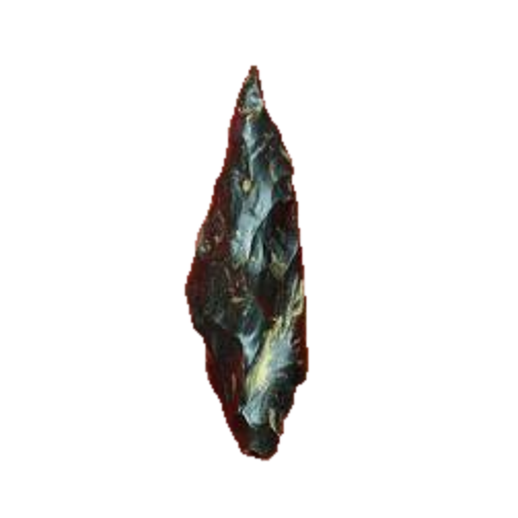
Arrowhead type
Bradley Spike Point
Bradley SpikeWoodland Spike Cluster4,000 - 1,800 B.P.Late Archaic to Early Woodland8 reference photos
Key facts
- Age
- 4,000 - 1,800 B.P.
- Cultural period
- Late Archaic to Early Woodland
- Size
- Small to Medium
- Shape
- Straight Stem to Contracting Stem
- Material
- Flint
- Glacial period
- Neoglacial to Roman Warm
Description
This narrow, stemmed projectile point exhibits a moderate thickness profile. In cross-section, its shape is predominantly elliptical, occasionally featuring a medial ridge, while thicker specimens may approach a circular form. The blade's curvature varies, spanning from excurvate to straight configurations. The shoulders are subdued, sloping upward at a gentle angle. The stem is generally straight, although some specimens may display a slight expansion or contraction. The base of the point ranges from straight to convex, often presenting an unfinished edge, or alternatively, showcasing basal grinding or thinning. The flaking pattern on this point is characterized by a random, non-directional arrangement of flakes.
Size
The dimensions of the arrowheads are as follows: they typically range in length from 40 to 65 mm, with an average length of 51 mm. The stem length varies between 7 and 15 mm, averaging 11 mm. The blade width ranges from 10 to 17 mm, with a mean width of 15 mm. Additionally, the stem width measures between 8 and 11 mm, averaging 10 mm. In terms of thickness, the arrowheads span from 6 to 14 mm.
Distribution
These artifacts are mainly discovered in the Tennessee River Valley and adjacent regions
Mainly found in
Also found, less often, in
Additional information
In the southeastern United States, specifically in Georgia and Florida, a distinct array of spike-type arrowheads has been identified, each with unique characteristics. Notably, the Bradley Spike exhibits a stem that can range from straight to contracting, terminating in a pointed base. In contrast, the Duval point features a stem that varies from straight to bulbous, while the Flint River point is distinguished by its rounded stem. The New Market point, on the other hand, displays a contracting stem, whereas the Schild point has a short, straight to slightly expanding stem. Additionally, the Florida Spike is recognizable by its straight to contracting stem, paired with a straight base.
These variations in stem morphology have been carefully documented by scholars, including Schroder, who has provided a comprehensive overview of these point types. The term "Woodland Spike" was initially used by Whatley to categorize all spike-type points from the Woodland period into a single group, acknowledging their shared cultural and temporal context. This classification has been acknowledged by Farr, who credits Whatley with coining the term, while Schroder attributes the name to Jerald Ledbetter. The Woodland period, spanning from approximately 1000 BCE to 1000 CE, is a significant cultural and chronological framework for understanding the development and distribution of these arrowhead types.
The study of these spike-type points offers valuable insights into the technological, social, and cultural practices of Native American communities in the southeastern United States during the Woodland period. By examining the variations in stem shape, base morphology, and overall design, archaeologists can reconstruct the complex networks of trade, cultural exchange, and technological innovation that characterized this region. Furthermore, the careful documentation and classification of these point types, as exemplified by the work of Schroder and others, demonstrate the importance of meticulous research and collaboration in advancing our understanding of Native American archaeology.
Identified by
- Named by
- Madeline Kneberg
- Year
- 1956
Similar types
Types that are easy to confuse with the Bradley Spike point.
- Briar Creek
- Buggs Island
- Collins
- Flint River Spike
- Guilford Stemmed
- Mountain Fork
- New Market
Other types in the Woodland Spike Cluster
- Duval
- Flint River
- Florida Spike
- Schild