
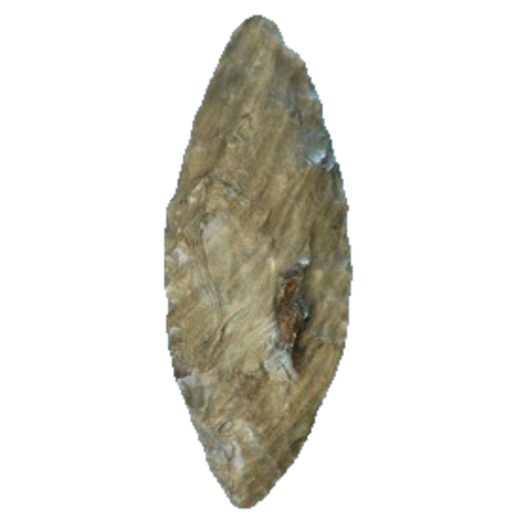
Arrowhead type
Kennewick Point
Kennewick8,000 - 5,000 B.P.Transitional Paleo10 reference photos
Key facts
- Age
- 8,000 - 5,000 B.P.
- Cultural period
- Transitional Paleo
- Culture
- Old Cordilleran Culture
- Size
- Medium to Large
- Shape
- Ovoid
- Material
- Obsidian
- Glacial period
- Middle Holocene
More from the Paleo period
Description
This ovoid point exhibits a slender profile, ranging from medium to large in size, with a cross-sectional shape that is broadly elliptical. In thicker specimens, a subtle median ridge may be present. The blade's curvature is characterized by an excurvate shape, where the edges converge at the tip and then recurve outward at the base, resulting in a tapered hafting area. Serrations often adorn the blade's edges. Notably, the hafting region typically lacks evidence of grinding. The point's base terminates in a sharp, pointed shape. The flaking pattern on these points can display a range of styles, including parallel oblique, collateral, or random arrangements.
Size
The dimensions of the arrowheads are characterized by the following measurements: overall length ranges from 25 to 135 mm, with a typical average length of 45 to 60 mm. The blade width varies between 11 to 30 mm, averaging between 11 to 18 mm. In terms of thickness, the arrowheads measure between 3 to 9 mm.
Distribution
This type is mainly located in the Columbia Plateau region of Washington and Oregon, stretching into northern Idaho and western Montana. It is also discovered throughout the Cascade Mountains and into the northern Sierra Nevada mountains of California and Nevada. It can also be discovered in the Okanagan Mountains of British Columbia and reaches the coastal areas
Mainly found in
Additional information
The discovery of a distinctive arrowhead, now commonly referred to as the Kennewick point, is inextricably linked to the renowned Kennewick Man, a significant archaeological find. This particular point was remarkably recovered from within the pelvis of the Kennewick Man, a discovery that has been extensively documented by Sally M. Walker and Douglas W. Owsley in their 2012 publication. The association of this arrowhead with the Kennewick Man has led many researchers and scholars to adopt the term "Kennewick point" when referencing this specific type of artifact. This naming convention not only acknowledges the point's origin but also underscores the importance of the Kennewick Man discovery in the field of archaeology.
The Kennewick point's discovery within the Kennewick Man's pelvis provides valuable insights into the cultural and historical context of this ancient individual. The presence of this arrowhead suggests a violent encounter, potentially shedding light on the circumstances surrounding the Kennewick Man's death. Furthermore, the recovery of this artifact has facilitated a deeper understanding of the technological and stylistic characteristics of arrowheads crafted by Native American cultures during this period. By examining the Kennewick point in conjunction with other archaeological evidence, researchers can reconstruct a more comprehensive narrative of the lives and experiences of ancient Native American communities.
The significance of the Kennewick point extends beyond its association with the Kennewick Man, as it also contributes to a broader understanding of the technological and cultural developments of Native American societies. The study of this artifact, in tandem with other archaeological findings, has the potential to reveal new information about the migration patterns, trade networks, and cultural exchange that occurred among ancient Native American groups. As such, the Kennewick point serves as a vital component in the ongoing effort to reconstruct and interpret the complex history of Native American cultures, highlighting the importance of continued archaeological research and discovery.
Identified by
- Named by
- B. Robert Butler
- Year
- 1961
Similar types
Types that are easy to confuse with the Kennewick point.