
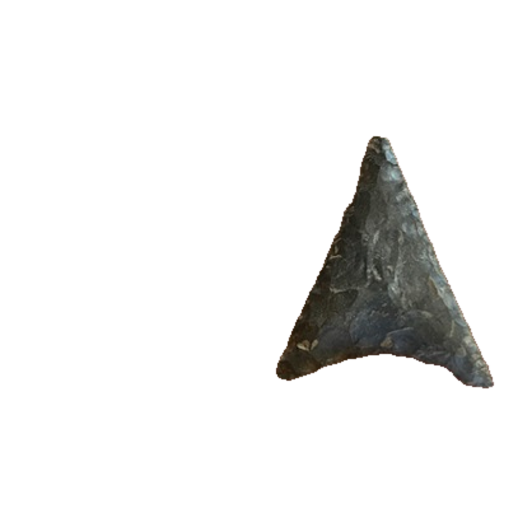
Arrowhead type
Susquehannock Triangle Point
Susquehannock TriangleLate Woodland Triangle Cluster to Early Mississippian Triangle Cluster1,300 - 600 B.P.Mississippian9 reference photos
Key facts
- Age
- 1,300 - 600 B.P.
- Cultural period
- Mississippian
- Culture
- Susquehannock (Conestoga) Culture
- Size
- Small to Medium
- Shape
- Triangle
- Material
- Jasper
- Glacial period
- Vandal Minimum to Medieval Warm
More from the Mississippian period
Description
This triangular point exhibits a versatile morphology, spanning a range of sizes from medium to small. In cross-section, the profile can vary from a compressed, flat shape to a more rounded, elliptical form, particularly in thicker specimens. The blade edge is generally straight, often forming a triangular shape that can be either isosceles, with a width roughly half its height, or equilateral, where the width and height are approximately equal. The basal margin typically displays a concave curvature, sometimes pronounced, although a few examples may have a nearly straight base. The flaking pattern on this point is characterized by a random, non-directional arrangement of flakes.
Size
The arrowheads exhibit a range of dimensions, with lengths spanning 18 to 40 mm, widths varying from 14 to 35 mm, and thicknesses measuring between 3 to 6 mm.
Distribution
This type is predominantly discovered in the Susquehanna River basin of Pennsylvania, extending into New York and Maryland, within regions linked to the Susquehannock Culture
Mainly found in
Additional information
The concurrent existence of the Shenks Ferry culture and the Susquehannock Culture, coupled with their overlapping geographical territories, presents a challenge in differentiating the triangular arrowhead points utilized by these two distinct cultural groups. Notably, the temporal coincidence of these cultures, which spanned the same time period, has led to a degree of ambiguity in identifying the specific points associated with each culture. However, a closer examination of the morphological characteristics of these points reveals a subtle yet discernible distinction.
Upon careful analysis, it becomes apparent that the triangular points attributed to the Shenks Ferry culture tend to exhibit a slightly narrower profile compared to those associated with the Susquehannock culture. This nuanced difference in width, although subtle, provides a valuable criterion for distinguishing between the arrowhead points used by these two cultures. By recognizing and accounting for this distinction, archaeologists can more accurately attribute the discovery of triangular points to either the Shenks Ferry or Susquehannock culture, thereby enhancing our understanding of the material culture and technological traditions of these ancient societies.
The identification of these cultural-specific characteristics is crucial for reconstructing the technological, social, and economic dynamics of the Shenks Ferry and Susquehannock cultures. By continuing to refine our understanding of the archaeological record, we can gain a more comprehensive insight into the lives and traditions of these Native American groups, ultimately enriching our appreciation of their cultural heritage and contributions to the rich tapestry of human history.
Identified by
- Named by
- John Witthoft
- Year
- 1959
Similar types
Types that are easy to confuse with the Susquehannock Triangle point.
- Erie Triangle
- Levanna
- Madison
- Shenks Ferry
- Squibnocket Triangle
- Yadkin