
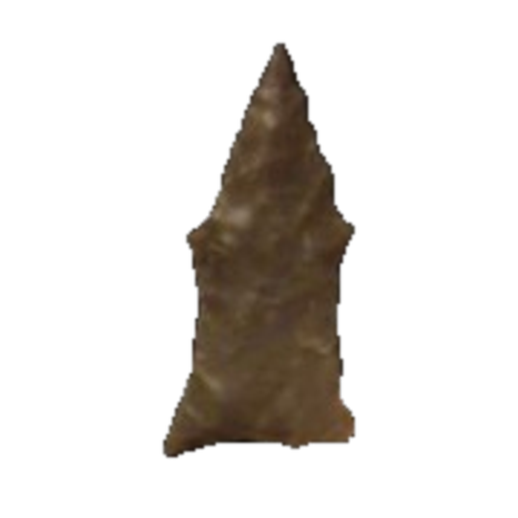
Arrowhead type
Mouse Creek Point
Mouse CreekMississippian Pentagonal Cluster1,500 - 500 B.P.Late Mississippian6 reference photos
Key facts
- Age
- 1,500 - 500 B.P.
- Cultural period
- Late Mississippian
- Culture
- Yuchi Culture
- Size
- Small to Medium
- Shape
- Triangle to Straight Stem to Expanding Stem
- Material
- Jasper
- Glacial period
- Roman Warm to Little Ice Age
More from the Mississippian period
Description
This pentagonal point exhibits a slender profile, characterized by a flattened cross-sectional morphology. The dorsal edge remains straight along the proximal third, before expanding outward in a subtle curve. In contrast, the distal two-thirds of the point display a pronounced incurvate shape, culminating in a distinctive protrusion at the junction of the straight and curved sections. The base of the point is marked by a concave margin, accentuated by sharp, angular basal corners. The flaking pattern observed on this artifact is random and unstructured. Dimensionally, this point falls within the following ranges: total length spans 21-50 mm, hafting length measures 13-22 mm, and basal width ranges from 11-20 mm.
Size
The arrowheads exhibit a range of dimensions, with overall lengths spanning 21 to 50 mm. The portion designated for hafting measures between 13 and 22 mm, while the basal width varies from 11 to 20 mm.
Distribution
This type is mainly located in the Tennessee River Valley region.
Also found, less often, in
Additional information
In the realm of Native American archaeology, the Yadkin and Levanna points are often regarded as a single type, distinguished primarily by their geographic distribution. The Levanna point is predominantly found in areas north of northern Virginia, whereas the Yadkin point is typically discovered in regions south of southern Virginia. A closer examination of their morphological characteristics reveals similarities that support this classification. However, discrepancies arise when considering the chronological context of these points. The Levanna point has been dated to a range of 700 A.D. to 1,350 A.D., based on research by Richie (1971) and Kinskey (1972), while the Yadkin point has been dated to a significantly earlier period, spanning from 300 B.C. to 800 A.D., as determined by radiocarbon dating of associated Yadkin ceramics.
The notable difference in dating may be attributed to variations in the methods employed or could indicate a northward shift in the usage of these points over time. A comparative analysis of the Yadkin and Badin points reveals that both are characterized by their large, triangular shape. Nevertheless, the Yadkin point exhibits a higher quality of flaking, suggesting a more refined craftsmanship. Interestingly, research suggests that the Badin point may predate the Yadkin type, according to studies conducted by the University of North Carolina. This chronological relationship highlights the complexities of Native American archaeological sequences and underscores the need for continued research into the technological and cultural developments of these ancient societies.
The distinction between the Yadkin and Levanna points serves as a reminder of the intricate regional variations that exist within Native American archaeological contexts. As researchers, it is essential to consider the nuances of geographic distribution, morphological characteristics, and chronological context to gain a deeper understanding of the cultural and technological trajectories of these ancient cultures. By examining the similarities and differences between point types, such as the Yadkin, Levanna, and Badin, archaeologists can reconstruct a more comprehensive narrative of Native American history, one that acknowledges the complexities and diversity of these ancient societies.
Identified by
- Named by
- Thomas M. N. Lewis and Madeline Kneberg
- Year
- 1941
- Type site
- Mouse Creek Site (40MN3), McNinn County, Tennessee
Similar types
Types that are easy to confuse with the Mouse Creek point.
- Jacks Reef Pentagonal
- Fort Ancient
- Madison
- Marianne
Other types in the Mississippian Pentagonal Cluster
- Pee Dee Pentagonal
- South Appalachian Pentagonal