
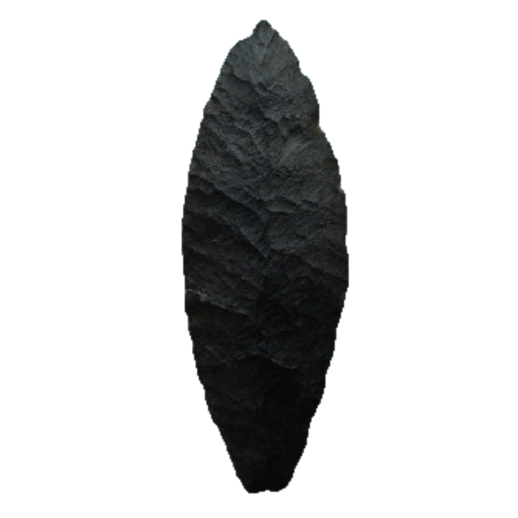
Arrowhead type
Humboldt Constricted Base Point
Humboldt Constricted BaseHumboldt Cluster7,000 - 3,000 B.P.Middle Archaic to Late Archaic13 reference photos
Key facts
- Age
- 7,000 - 3,000 B.P.
- Cultural period
- Middle Archaic to Late Archaic
- Size
- Small to Medium
- Shape
- Auriculate to Lanceolate
- Glacial period
- Middle Holocene to Neoglacial
More from the Archaic period
Description
This lanceolate point exhibits a slender, elongated form with an elliptical profile. Its blade features a distinctive excurvate morphology, characterized by an inward curvature at the midpoint, where the sides become nearly parallel, and a recurved base. The base of the point is narrower than its maximum blade width, and its edge is typically concave to notched. The basal area often displays evidence of thinning and grinding, suggesting deliberate shaping and refinement. The flaking pattern on this point is predominantly oblique transverse, although some specimens may exhibit a more random or irregular flaking arrangement.
Size
The dimensions of the arrowheads are characterized by the following measurements: overall length ranges from 23 to 85 mm, with a typical average length spanning between 35 and 45 mm. The maximum width of the blade varies from 14 to 25 mm, while the basal width is measured between 7 and 15 mm. Additionally, the basal concavity is observed to be between 1 and 5 mm, and the thickness of the arrowhead is recorded as being between 4 and 7 mm.
Distribution
This style is prevalent across the Great Basin and stretches into the Colorado Plateau (red). Humboldt type points reach into the coastal areas of California, but are referred to as Mendocino Concave and Buchanan Eared in those regions (yellow)
Additional information
The emergence of Humboldt points on the Colorado Plateau is a notable phenomenon, marked by a relatively brief presence spanning approximately 7,300 to 6,800 years before present (B.P.), as documented by Berry and Berry (1986). A distinctive variant of these points, known as the Triple T, is characterized by its wider blade and concaved base, and is considered the oldest form of Humboldt point, according to Thomas (1983). Initially, researchers attempted to differentiate Humboldt points from McKean points based on their flaking patterns, with McKean points typically exhibiting collateral style flaking, whereas Humboldt points were thought to display oblique transverse style flaking. However, Hattori (1982) observed that Humboldt points can also exhibit random style flaking, which complicates this distinction.
The flaking pattern on Humboldt points is not always consistent, and this variability underscores the complexity of these artifacts. Despite these challenges, the study of Humboldt points remains crucial for understanding the technological and cultural developments of the region. The possible continuity of Humboldt points into the Fremont culture is a significant area of inquiry, with some researchers suggesting that these points may have been repurposed as knives. This potential adaptation highlights the resourcefulness and ingenuity of the people who created and used these points, and underscores the importance of continued research into the lives and traditions of Native American communities on the Colorado Plateau.
The characteristics of Humboldt points, including their morphology and flaking patterns, offer valuable insights into the lives of the people who crafted and utilized them. As archaeologists continue to study these artifacts, they are gaining a deeper understanding of the cultural and technological contexts in which they were created. The presence of Humboldt points on the Colorado Plateau, although brief, is a significant aspect of the region's archaeological record, and their potential connection to the Fremont culture underscores the complex and dynamic nature of Native American cultural development in this region. By examining these points in detail, researchers can reconstruct the daily lives, technological innovations, and cultural exchange networks of the people who created them, ultimately enriching our understanding of the rich and diverse heritage of Native American communities.
Identified by
- Named by
- Robert F. Heizer and C. William Clewlow Jr.
- Year
- 1968
- Type site
- Lovelock Lake Bed Site, Humboldt Sink, Nevada
Similar types
Types that are easy to confuse with the Humboldt Constricted Base point.
- Allen
- Bat Cave
- Black Rock
- Fourth of July Lanceolate
- Green River
- Mendocino Concaved
- Meserve
- Pinto Shoulderless
- Plainview
- Tulare Lake
Other types in the Humboldt Cluster
- Buchanan Eared
- Humboldt Constricting Base
- Humboldt Basal Notched
- Humboldt
- Humboldt Expanding Base
- Mendocino Concave