
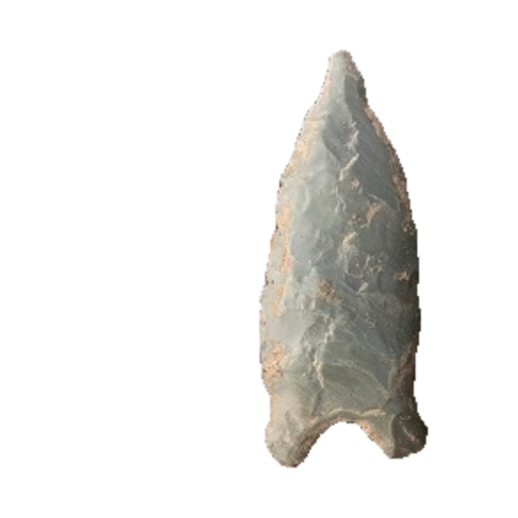
Arrowhead type
Mendocino Concave Point
Mendocino ConcaveHumboldt Cluster5,000 - 2,500 B.P.Middle Archaic4 reference photos
Key facts
- Age
- 5,000 - 2,500 B.P.
- Cultural period
- Middle Archaic
- Size
- Medium
- Shape
- Auriculate to Lanceolate
- Material
- Limestone
- Glacial period
- Middle Holocene to Neoglacial
More from the Archaic period
Description
This medium-sized lanceolate point exhibits a robust profile, characterized by an elliptical cross-sectional shape. Its blade curvature is pronounced, displaying a distinctive excurvate morphology. The basal morphology is notable for its concave to notched configuration. In terms of flaking patterns, the point showcases a predominantly oblique transverse pattern, although occasional random flaking is also evident, adding complexity to its overall technological signature.
Size
The arrowheads exhibit a range of dimensions, with overall lengths spanning 23 to 75 mm, and averaging between 35 to 45 mm. The maximum width of the blade varies from 11 to 43 mm. In terms of basal dimensions, the width is slightly less than that of the blade, while the basal concavity measures between 3 to 6 mm. The thickness of the arrowheads ranges from 6 to 10 mm.
Distribution
This projectile is mainly discovered in the northern shoreline areas of California (red). It is viewed as a localized variation, or potentially an identical style, of the Humboldt point which has a widespread presence in the Great Basin area (yellow)
Also found, less often, in
Additional information
In the realm of Native American archaeology, a distinctive arrowhead variant has been identified in northwestern California, which bears a striking resemblance to the Humboldt point, as noted by Justice in 2002. This particular type of point is often discovered in conjunction with, and can be easily confused with, Albion Head points and preforms. However, upon closer examination, it becomes apparent that these points are characterized by their thicker and larger dimensions, as well as a pronounced concave notch, which distinguishes them from the more shallowly notched Albion Head points and preforms.
The Humboldt point, to which this variant is closely related, is typically associated with a Great Basin distribution. In contrast, the northwestern California variant exhibits a more localized distribution, primarily confined to central and coastal regions of California. This geographic disparity has led some researchers to suggest that the Mendocino Concave, another point type, may be synonymous with the Humboldt point, highlighting the complexities and nuances of arrowhead typology. The shared characteristics and overlapping distributions of these point types underscore the need for careful analysis and consideration of regional variations in the study of Native American archaeology.
Notably, the northwestern California variant of the Humboldt point offers valuable insights into the technological and cultural adaptations of the indigenous populations that inhabited this region. The distinctive concave notch and larger size of these points may reflect specific functional requirements or cultural preferences, which are worthy of further investigation. By examining the distribution, morphology, and cultural context of these arrowheads, researchers can gain a deeper understanding of the lives and traditions of the Native American communities that crafted and utilized them, shedding light on the rich and complex history of human presence in this region.
Identified by
- Named by
- Frank J. Soday
- Year
- 1954
- Type site
- Quad Site, Limestone County, Alabama
Similar types
Types that are easy to confuse with the Mendocino Concave point.
- Albion Head
- Buchanan Eared
- Humboldt
Other types in the Humboldt Cluster
- Humboldt Constricting Base
- Humboldt Basal Notched
- Humboldt Expanding Base