
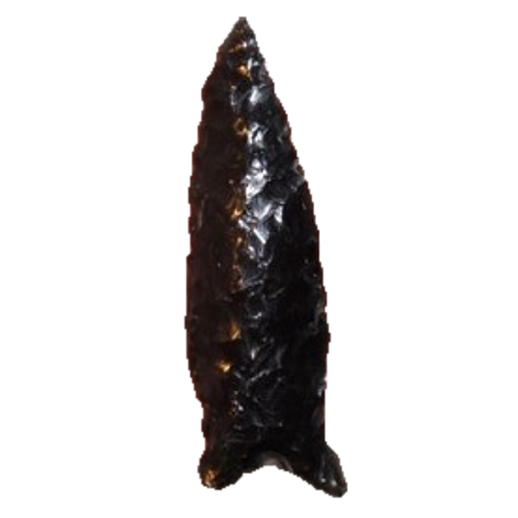
Arrowhead type
Buchanan Eared Point
Buchanan EaredHumboldt Cluster4,000 - 1,500 B.P.Late Archaic to Transitional Archaic5 reference photos
Key facts
- Age
- 4,000 - 1,500 B.P.
- Cultural period
- Late Archaic to Transitional Archaic
- Size
- Medium to Large
- Shape
- Auriculate to Lanceolate
- Glacial period
- Middle Holocene to Roman Warm
More from the Archaic period
Description
This lanceolate point exhibits a size range from medium to large, characterized by a cross-sectional profile that is either elliptical or features a pronounced median ridge. The blade itself displays a distinctive outward recurvature, broadening noticeably as it approaches the base. In some instances, the shoulders above the auricular extensions may be subtly defined, while in others, the blade edges remain straight until the base begins to flare, forming the characteristic ear-like protrusions. The basal morphology can vary, ranging from a concave to a notched configuration. The flaking pattern typically presents as oblique transverse, although some specimens may exhibit a more randomized flaking arrangement.
Size
The arrowheads exhibit a range of dimensions, with overall lengths spanning 25 to 125 mm, and averaging between 35 to 45 mm. The maximum width of the blade varies from 14 to 32 mm, while the basal width ranges from 18 to 31 mm. Additionally, the basal concavity measures between 3 to 7 mm, and the thickness of the arrowheads falls within the range of 6 to 11 mm.
Distribution
This projectile is discovered throughout the southern Sierra Nevada area and into the southern Central Valley of California (red), This projectile is regarded as a localized variation, or potentially the same style, of the Humboldt Expanding Base point which has a Great Basin dispersion (yellow)
Additional information
In the realm of Native American arrowhead typology, the point in question is recognized as a variant of the Humboldt point, a distinctive archaeological artifact. Notably, a similar type, known as the Humboldt Expanded Base, exhibits a geographic distribution primarily confined to the Great Basin region. Interestingly, some researchers have proposed that the Buchanan Eared and Humboldt Expanded Base types may, in fact, represent a single, cohesive type, highlighting the complexities of archaeological classification.
The Buchanan Eared type is frequently discovered in conjunction with the Mendocino Concave Base, which is often considered synonymous with the Humboldt point. This association underscores the intricate relationships between various arrowhead types and their corresponding cultural contexts. Furthermore, the Humboldt Expanded Base is also commonly found in association with the Humboldt point, suggesting a degree of overlap or co-occurrence between these two types. These findings contribute to a deeper understanding of the technological and stylistic developments within Native American cultures, particularly in the Great Basin and surrounding regions.
The study of these arrowhead types, including the Humboldt point and its variants, offers valuable insights into the lives and traditions of Native American communities. By examining the distribution, association, and characteristics of these artifacts, archaeologists can reconstruct aspects of the cultural, social, and economic practices of these groups, ultimately enriching our comprehension of the rich and diverse heritage of Native American cultures. The nuances of arrowhead typology, as exemplified by the Humboldt point and its related types, demonstrate the complexity and sophistication of Native American technological and artistic expression.
Identified by
- Named by
- Michael Moratto
- Year
- 1972
- Type site
- Buchanan Site, Buchanan Reservoir, California
Similar types
Types that are easy to confuse with the Buchanan Eared point.
- Black Rock
- Pinto Shoulderless
- Tulare Lake
Other types in the Humboldt Cluster
- Humboldt Constricting Base
- Humboldt Basal Notched
- Humboldt
- Humboldt Expanding Base
- Mendocino Concave