
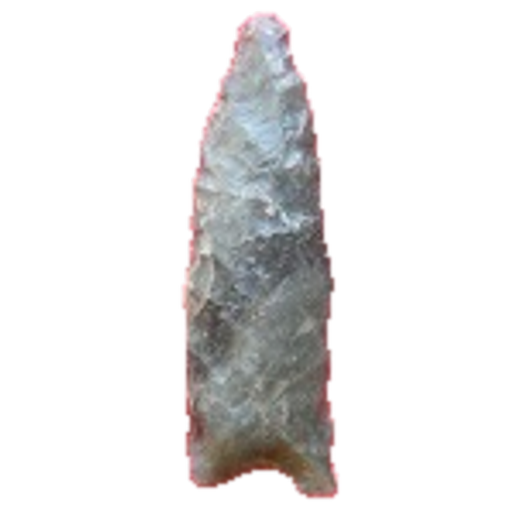
Arrowhead type
Humboldt Basal Notch Point
Humboldt Basal NotchHumboldt Cluster7,000 - 3,000 B.P.Middle Archaic to Late Archaic2 reference photos
Key facts
- Age
- 7,000 - 3,000 B.P.
- Cultural period
- Middle Archaic to Late Archaic
- Size
- Small to Medium
- Shape
- Auriculate to Lanceolate
- Glacial period
- Middle Holocene to Neoglacial
More from the Archaic period
Description
This lanceolate point exhibits a distinctive morphology, characterized by a medium size and a cross-sectional profile that transitions from elliptical to flattened. The blade's curvature varies, spanning from excurvate to straight, with the Basal Notch variant often displaying more pronounced ears and a tendency towards a straighter blade configuration. The basal area is marked by variability, ranging from a concave to a notched shape. A notable feature of this point is the presence of basal thinning and grinding, which is typically observed. In terms of flaking patterns, the classic arrangement is oblique transverse, although some specimens may exhibit a more randomized pattern, adding to the point's technological complexity.
Size
The arrowheads exhibit a range of dimensions, with overall lengths spanning 25 to 115 mm, and averaging between 35 to 45 mm. The maximum width of the blade varies from 14 to 40 mm, while the basal concavity measures between 3 to 5 mm. In terms of thickness, these artifacts range from 4 to 7 mm.
Distribution
This projectile is distributed across the Great Basin and stretches into the Colorado Plateau (red). Humboldt type projectiles reach into the coastal areas of California, but are referred to as Mendocino Concave and Buchanan Eared in those regions (yellow)
Additional information
The emergence of Humboldt points on the Colorado Plateau is a notable phenomenon, marked by a relatively brief presence spanning approximately 7,300 to 6,800 years before present (B.P.), as documented by Berry and Berry (1986). A distinctive variant of these points, known as the Triple T, is characterized by its wider blade and concaved base, and is considered the oldest form of Humboldt points, according to Thomas (1983). Initially, researchers attempted to differentiate Humboldt points from McKean points based on their flaking patterns, with McKean points typically exhibiting collateral style flaking, whereas Humboldt points were thought to display oblique transverse style flaking. However, Hattori (1982) observed that Humboldt points can also exhibit random style flaking, which complicates this distinction.
The flaking pattern on Humboldt points is not always consistent, and this variability highlights the complexity of these artifacts. Despite these challenges, the study of Humboldt points remains crucial for understanding the technological and cultural developments of the region. The possible continuation of Humboldt points into the Fremont culture, where they may have been repurposed as knives, is a significant aspect of their history. This potential overlap underscores the dynamic nature of prehistoric cultures and the adaptive reuse of artifacts.
The characteristics of Humboldt points, including their wider blades and concaved bases, as well as their variable flaking patterns, provide valuable insights into the lives and technologies of the people who created them. As archaeological research continues to uncover the history of the Colorado Plateau, the study of Humboldt points remains an essential component of our understanding of the region's cultural and technological evolution. By examining these points in their historical and cultural context, we can gain a deeper appreciation for the ingenuity and adaptability of the prehistoric peoples who inhabited this region.
Identified by
- Named by
- Robert F. Heizer and C. William Clewlow Jr.
- Year
- 1968
- Type site
- Lovelock Lake Bed Site, Humboldt Sink, Nevada
Similar types
Types that are easy to confuse with the Humboldt Basal Notch point.
- Allen
- Bat Cave
- Black Rock
- Fourth of July Lanceolate
- Green River
- Mendocino Concaved
- Meserve
- Pinto Shoulderless
- Plainview
- Tulare Lake
Other types in the Humboldt Cluster
- Buchanan Eared
- Humboldt Constricting Base
- Humboldt
- Humboldt Expanding Base
- Mendocino Concave