
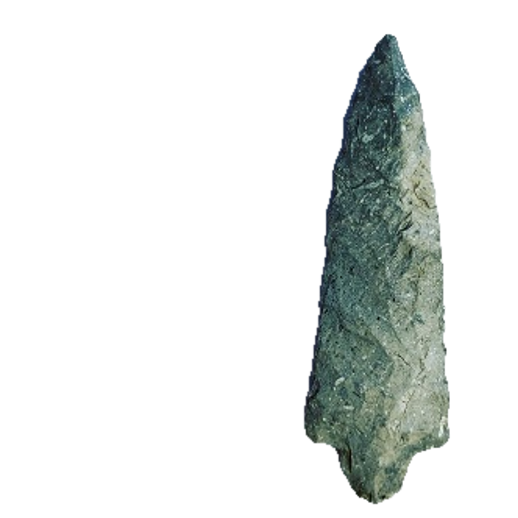
Arrowhead type
Gypsum Point
GypsumGypsum Cave Cluster4,000 - 2,800 B.P.Late Archaic17 reference photos
Key facts
- Age
- 4,000 - 2,800 B.P.
- Cultural period
- Late Archaic
- Culture
- Oshara Tradition
- Size
- Medium
- Shape
- Contracting Stem to Ovoid
- Glacial period
- Neoglacial
More from the Archaic period
Description
The medium-sized point exhibits a cross-sectional profile that transitions from flat to elliptical in shape. Its blade morphology varies, ranging from straight to excurvate, and may feature serrations along its edge. The shoulder orientation is typically inclined upwards, although some specimens display horizontal or barbed configurations. A distinctive feature of this point is its stem, which contracts towards the base, forming a convex termination. Notably, basal grinding is rarely observed on this type of point. The flaking pattern on this artifact is characterized by a random, non-patterned arrangement of flakes, lacking a deliberate or organized sequence.
Size
The dimensions of the arrowheads are as follows: they range in overall length from 34 to 59 mm, with a mean length of 42 mm. The stem length varies between 7 and 14 mm. The width of the blade spans 19 to 27 mm, averaging 24 mm. At the shoulders, the stem width measures between 6 and 16 mm, while the basal width ranges from 1 to 5 mm. The thickness of the arrowheads falls within a range of 4 to 8 mm.
Distribution
This projectile is distributed across the southern Great Basin and the southern Colorado Plateau, extending into the southwest and reaching northern Sonora and northern Baja California, Mexico. This style was discovered at the La Playa site in northern Sonora, Mexico
Mainly found in
Additional information
The Gypsum point is a distinctive artifact of the Archaic period, notable for its potential role in the evolution of hafting technology. Originating in Mexico around 7,000 years before present, these points are believed to have migrated northward into the Great Basin region. As noted by Marmaduke in 1978, this migration pattern is significant in understanding the cultural exchange and technological developments of the time.
The Gypsum point has been associated with various cultural complexes, periods, and phases, including the Newberry Period, Pinto Gypsum Complex, Early and Middle Rose Springs Period, Armargosa I and III, Death Valley II, and Ray Phase, as documented by Des Planques in 2001. Initially, all contracting stem projectile points found in the Great Basin and Colorado Plateau were categorized as Gypsum points. However, as researchers conducted further analysis, they began to distinguish between different point types based on the techniques and technologies employed in their manufacture. Justice's 2002 study, for example, highlighted the importance of reevaluating these points and recognizing the diversity of forms and functions within the Gypsum point category.
Despite the refinement of point typologies, the term "Gypsum point" remains widely used to refer to contracting stem points, even as many of these points have been reclassified into distinct types. This persistence of the Gypsum point designation underscores the complexity and nuance of archaeological classification, as well as the ongoing efforts to refine our understanding of the technological and cultural developments of the Archaic period. By examining the characteristics and distribution of Gypsum points, researchers can gain valuable insights into the lives and traditions of the people who created and used these artifacts, and shed light on the dynamic cultural landscape of the Great Basin region during this pivotal period in North American prehistory.
Identified by
- Named by
- Robert E. Harrington
- Year
- 1933
- Type site
- Gypsum Cave (near Las Vegas), Nevada
Similar types
Types that are easy to confuse with the Gypsum point.
Other types in the Gypsum Cave Cluster
- Pinto Basin