
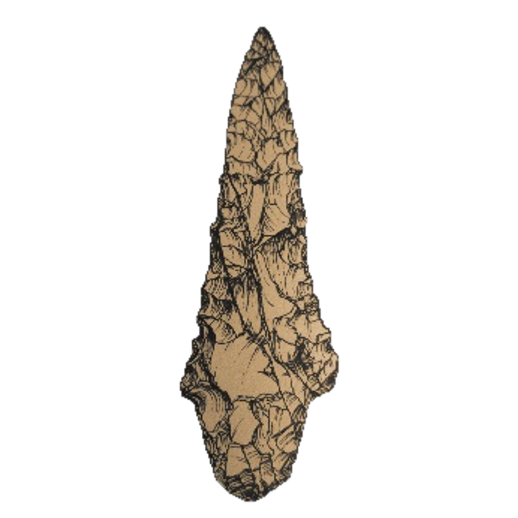
Arrowhead type
Houx Point
HouxCoastal Contracting Stem Cluster4,500 - 1,500 B.P.Late Archaic to Transitional Archaic5 reference photos
Key facts
- Age
- 4,500 - 1,500 B.P.
- Cultural period
- Late Archaic to Transitional Archaic
- Size
- Medium to Large
- Shape
- Contracting Stem
- Material
- Obsidian
- Glacial period
- Neoglacial to Roman Warm
More from the Archaic period
Description
This artifact exhibits a broad, triangular morphology with a tapering stem, characterized by an elliptical profile. The blade's curvature can vary, ranging from a straight edge to a subtly excurvate shape, and may feature serrations along its length. The shoulders often display asymmetry, with their orientation spanning from a horizontal alignment to a more pronounced, barbed configuration. The stem narrows towards its base, which can be either convex or terminate in a pointed tip. The manufacturing process involves an initial stage of primary percussion flaking, followed by pressure flaking to refine the blade and stem. The resulting flake scars typically exhibit a random pattern, although chevron or oblique arrangements can also occur.
Size
The dimensions of the arrowheads are as follows: they range in overall length from 37 to 71 mm, with stem lengths varying between 12 and 20 mm. The width of the blade spans from 18 to 32 mm, while the stem width at the shoulder measures between 10 and 21 mm. In terms of thickness, the arrowheads are between 8 and 11 mm.
Distribution
This style is mainly discovered in the northern Coastal Mountains, the Central Plains, and the San Francisco Bay region. This variety is often located alongside Excelsior style points, and were formerly classified under that variety. Excelsior points have been identified as far as Baja California, suggesting these styles may also reach into that territory
Mainly found in
Additional information
In the realm of Native American archaeology, the classification of arrowhead types has undergone significant refinement over the years. Notably, a particular type of arrowhead was initially categorized under the Excelsior type, as documented by Justice in 2002. This earlier classification has since been reevaluated, leading to a more nuanced understanding of the distinct characteristics that define this specific type of arrowhead. The recognition of this type as a separate entity has provided valuable insights into the technological and cultural developments of the Native American groups that crafted these artifacts.
The reclassification of this arrowhead type is a testament to the ongoing efforts of archaeologists to refine their understanding of the material culture of Native American societies. By reexamining the characteristics and attributes of these artifacts, researchers can gain a deeper appreciation for the complexities of prehistoric technologies and the cultural contexts in which they were created. The work of Justice in 2002 serves as a foundational reference point for this type, highlighting the importance of continued research and analysis in the field of archaeology.
The distinction of this arrowhead type from the Excelsior type has significant implications for our understanding of the historical and cultural landscape of Native American communities. As archaeologists continue to study and refine their knowledge of these artifacts, they are able to reconstruct a more detailed and accurate picture of the lives and traditions of the people who created them. By examining the characteristics and distribution of these arrowheads, researchers can shed light on the technological, social, and cultural developments of Native American groups, ultimately enriching our understanding of the rich and diverse heritage of these communities.
Identified by
- Named by
- Martin A. Baumhoff
- Year
- 1981
- Type site
- Houx Site (Ca Lak 261), Clear Lake, Lake County, California
Similar types
Types that are easy to confuse with the Houx point.
- Coquille
- Gatecliff
- Gypsum
- Sierra Contracting
Other types in the Coastal Contracting Stem Cluster
- Channel Islands Barbed
- Excelsior
- Houx Contracting Stem
- Point Sal Barbed
- Vandenberg Contracting Stem