
Arrowhead type
Greenville Point
GreenvilleCopena Cluster2,100 - 1,750 B.P.Early Woodland to Middle Woodland5 reference photos
Key facts
- Age
- 2,100 - 1,750 B.P.
- Cultural period
- Early Woodland to Middle Woodland
- Size
- Medium
- Shape
- Lanceolate to Triangle
- Glacial period
- Roman Warm
More from the Woodland period
Description
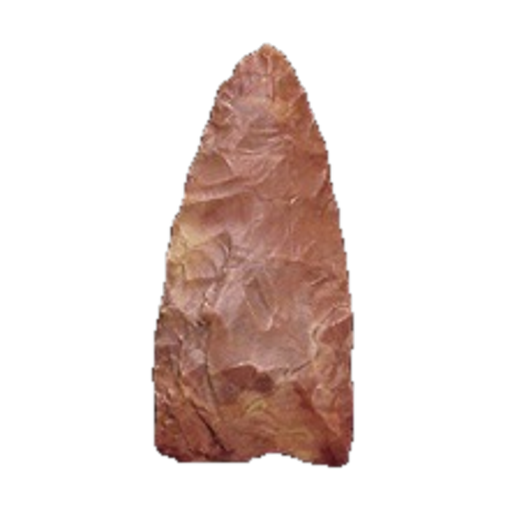
This lanceolate point measures between 1.25 and 2 inches in length and exhibits an elliptical cross-sectional profile. The blade's morphology is characterized by an excurvate shape, with curvature concentrated at the distal tip and sides that are either parallel or slightly convergent. In contrast, the proximal hafting area tends to be straight. Secondary flaking is a prevalent feature on the blade of most specimens. The basal margin can display variability, ranging from a slightly concave to a slightly convex configuration. Additionally, basal thinning is a common trait observed in these points, which often exhibit a random, non-patterned flaking arrangement.
Size
The arrowheads exhibit a range of dimensions, with total lengths spanning from 29 to 50 mm, and averaging between 33 to 40 mm. In terms of width, they measure between 15 to 30 mm, with an average range of 19 to 22 mm. The thickness of these artifacts falls within a range of 6 to 9 mm.
Distribution
This type is mainly discovered from the western fringe of the Appalachian Mountains to Greenville, Tennessee, and into southern Alabama. This type can also be located throughout the Tennessee River Valley and its surrounding streams
Also found, less often, in
Additional information
In comparison to the Guntersville point, this particular arrowhead type exhibits distinct dimensional characteristics. Notably, it tends to be broader in width and thicker in cross-section, setting it apart from its Guntersville counterpart. This difference in morphology suggests that the manufacturing techniques, raw materials, or functional requirements may have varied between the cultures that produced these points, highlighting the diversity of technological and stylistic expressions among Native American groups.
The wider and thicker profile of this arrowhead type may indicate a specific use or adaptation to certain environments, which could be an area of further investigation. Understanding the variations in arrowhead morphology can provide valuable insights into the lives and traditions of the people who created them, as well as the ecological contexts in which they were used. By examining these physical characteristics, archaeologists can gain a deeper appreciation for the complexity and richness of Native American cultural heritage.
The study of arrowhead morphology, including the comparison of dimensions such as width and thickness, is a crucial aspect of archaeological research. It allows scholars to reconstruct the technological, social, and cultural dynamics of past societies, shedding light on the history and development of Native American communities. As researchers continue to analyze and interpret the physical attributes of arrowheads like this one, they may uncover new patterns, trends, or correlations that enhance our understanding of these ancient artifacts and the people who crafted them.
Identified by
- Named by
- Madeline Kneberg and Thomas M. N. Lewis
- Year
- 1957
- Type site
- Camp Creek Site, near Greenville, Greene County, Tennessee
Similar types
Types that are easy to confuse with the Greenville point.
- Camp Creek
- Clarksville
- Frazier
- Guntersville
- Madison
Other types in the Copena Cluster
- Candy Creek
- Copena
- Copena Articulated
- Copena Round Base
- Copena Triangular