
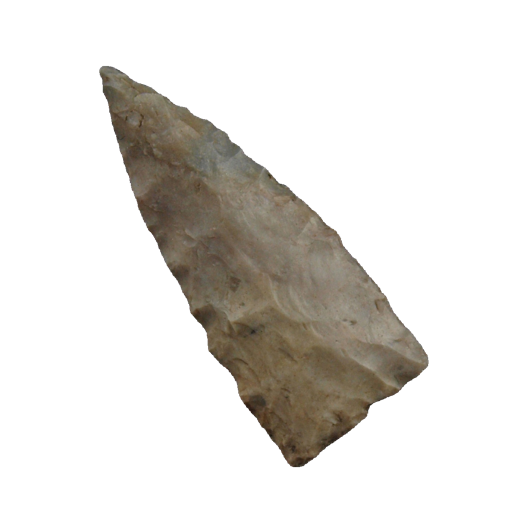
Arrowhead type
Guntersville Point
Guntersville750 - 200 B.P.Late Mississippian to Historic12 reference photos
Key facts
- Age
- 750 - 200 B.P.
- Cultural period
- Late Mississippian to Historic
- Culture
- Mouse Creek, Dallas, Lamar, Cherokee Cultures
- Size
- Small to Medium
- Shape
- Lanceolate to Triangle
- Glacial period
- Little Ice Age
More from the Mississippian, Historic periods
Description
This lanceolate point exhibits a slender profile, characterized by a cross-sectional shape that ranges from flattened to elliptical. Its narrow blade features an excurvate silhouette, where the tip curves inward and the edges converge to form a parallel alignment. The base of the point is typically straight, although minor deviations can occur. A notable feature of this point is the presence of basal thinning, which suggests a deliberate attempt to reduce weight and enhance balance. The flaking pattern on this point appears to be random, yet the overall craftsmanship is of high quality, indicating a skilled manufacturer.
Size
The dimensions of the arrowheads are as follows: they typically range in total length from 27 to 50 mm, with an average length of 29 to 35 mm. In terms of width, they measure between 10 to 18 mm, averaging 13 to 14 mm. The thickness of the arrowheads falls within a range of 4 to 6 mm.
Distribution
This type is mainly discovered in the Tennessee River Valley and extending into southwestern Georgia, northern Alabama, and southeastern Mississippi.
Mainly found in
Also found, less often, in
Additional information
In the realm of Native American archaeology, a particular type of arrowhead is frequently discovered in conjunction with Madison and Fort Ancient points, as noted by Cambron and Hulse in their 1975 research. This point is characterized by variations in workmanship quality, with some examples exhibiting exceptional craftsmanship. The Dallas point, named by T.N.M. Lewis, is a notable example of high-quality workmanship, demonstrating a level of skill and attention to detail that distinguishes it from other types. In contrast, the Gunthersville type point is marked by slightly cruder construction, highlighting the diversity of techniques and materials employed by Native American cultures.
The Dallas point is a significant find in archaeological contexts, offering insights into the technological and cultural developments of Native American societies. The classification of a point as a Dallas point is based on its distinctive characteristics, which set it apart from other types. For instance, the first and last pictures of a particular point would be categorized as a Dallas point due to their adherence to the specific traits that define this type. This classification is crucial in understanding the cultural associations and trade networks of Native American groups, as well as the evolution of arrowhead technology over time.
The study of Dallas points and their variants, such as the Gunthersville type, provides a unique window into the lives and traditions of Native American communities. By examining the workmanship, materials, and distribution of these points, archaeologists can reconstruct the social, economic, and cultural contexts in which they were created and used. The analysis of these artifacts not only sheds light on the technological advancements of Native American societies but also highlights the complexity and diversity of their cultural practices, underscoring the importance of continued research and exploration in this field.
Identified by
- Named by
- James Cambron and David Hulse
- Year
- 1975
- Type site
- Comment: This point was first described and named the Dallas component by T.N.M Lewis and Madeline Kneberg in 1946 for the Dallas Focus of the Tennessee River. Type Site Dallas Site (8HA1) Hamilton County, Tennessee
Similar types
Types that are easy to confuse with the Guntersville point.
- Camp Creek
- Greenville
- Hamilton
- Ichetucknee
- Madison
- Nodena
- Tallahassee
Other types in this cluster
- Fort Ancient