
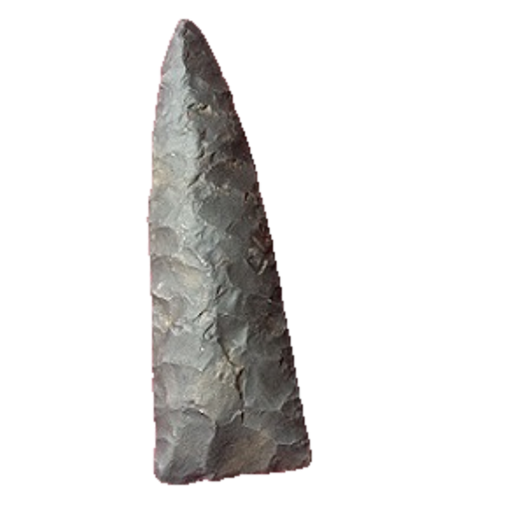
Arrowhead type
Fredrick Lanceolate Point
Fredrick LanceolatePlano Lanceolate Cluster9,500 - 8,500 B.P.Early Archaic2 reference photos
Key facts
- Age
- 9,500 - 8,500 B.P.
- Cultural period
- Early Archaic
- Size
- Medium to Large
- Shape
- Auriculate to Lanceolate to Triangle
- Material
- Agate
- Glacial period
- Early Holocene
More from the Archaic period
Description
This lanceolate point exhibits a slender, triangular profile with a cross-sectional shape that ranges from elliptical to flattened. The blade's curvature is subtly excurvate, with its maximum width typically situated above the base. The basal edge displays variability, ranging from a straight line to a gentle concavity. Evidence of grinding is often present in the hafting area, suggesting deliberate shaping for attachment. The flaking pattern on this point is characterized by parallel to oblique scars, indicating a consistent and controlled flaking technique.
Size
The arrowhead's dimensions are characterized by a total length ranging from 60 to 80 mm, a blade width spanning 20 to 30 mm, and a basal concavity measuring between 0 and 3 mm.
Distribution
This type is mainly discovered in the western grasslands and extending into the Rocky Mountain range. They appear to be linked with elevated terrain in these areas. These points are also discovered in the southern grasslands area and into northeastern New Mexico
Additional information
In the realm of Native American arrowheads, a distinct type of point has been identified, bearing similarities to the James Allen point, yet exhibiting a notable difference in its basal morphology. Specifically, the base of this point is characterized by a straight to slightly concave shape, diverging from the deeply concave base of the James Allen point. This distinction is a key factor in differentiating between these two point types.
As observed by Frison (1991), the emergence of this point type marks a significant shift in the technological and stylistic evolution of arrowhead design. It represents a departure from the earlier stemmed points, which featured transverse pressure flaking, towards a more lanceolate form with parallel oblique flaking. This transformation is a testament to the adaptability and innovation of the Native American cultures that crafted these points. The type site in Wyoming, where Jimmy Allen points were first discovered, has yielded points that are remarkably similar to Frederick points, with the primary distinction being the deep basal concavity present in the Jimmy Allen points.
The study of these point types offers valuable insights into the cultural and technological developments of Native American societies. The subtle variations in basal morphology and flaking patterns underscore the complexity and nuance of arrowhead design, highlighting the importance of meticulous analysis and classification in archaeological research. By examining these points in their cultural and historical context, researchers can gain a deeper understanding of the lives and traditions of the people who created them, shedding light on the rich and diverse heritage of Native American cultures.
Identified by
- Named by
- Henry. T. Irwin
- Year
- 1958
- Type site
- Abajo Site (29SJ116), San Juan County, New Mexico
Similar types
Types that are easy to confuse with the Fredrick Lanceolate point.
- Agate Basin
- Alder
- Angostura
- Browns Valley
- Fourth of July Lanceolate
- Golondrina
- Goshen
- James Allen
- Meserve
- Midland
- Plainview
Other types in the Plano Lanceolate Cluster
- Lusk