
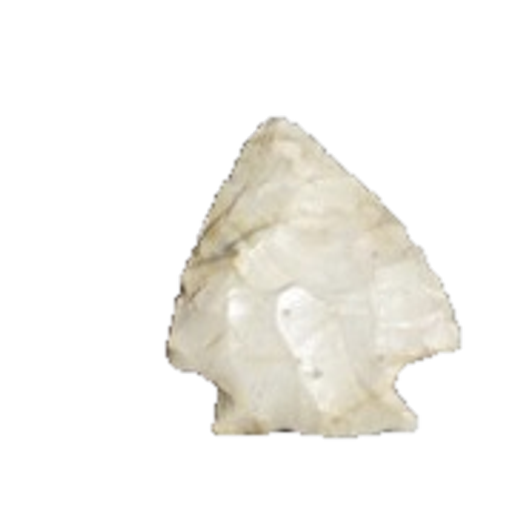
Arrowhead type
Feeheley Point
FeeheleyBrewerton Corner Notch Cluster5,000 - 3,000 B.P.Middle Archaic to Late Archaic2 reference photos
Key facts
- Age
- 5,000 - 3,000 B.P.
- Cultural period
- Middle Archaic to Late Archaic
- Size
- Medium
- Shape
- Corner Notch to Side Notch to Expanding Stem
- Glacial period
- Middle Holocene
More from the Archaic period
Description
This triangular point exhibits a compact to moderate size, characterized by an elliptical profile. The blade's curvature is predominantly outward, although it can also appear straight or, less frequently, inward. Notch formation occurs at the blade's corners, resulting in a diagonal orientation with a stem that widens towards the base. The shoulders display a range of barb development, from subtle to pronounced. The basal edge is typically straight, but occasional specimens may display a slight concavity. The flaking pattern on this point is non-directional and irregular, lacking a discernible order or orientation.
Size
The arrowheads exhibit a range of dimensions, with lengths spanning 24 to 79 mm. The stem, a distinctive feature, measures between 7 and 11 mm in length. In terms of width, the blade ranges from 20 to 40 mm, while the stem width varies from 10 to 22 mm. The neck, a critical juncture, has a width of 10 to 18 mm. Thickness, a key metric, falls within the range of 6 to 11 mm.
Distribution
The difference between this arrowhead and the Brewerton Corner Notch lies mainly in its geographical range. This type is mainly linked to Michigan and spans the entire Ohio River Valley. In contrast, the Brewerton type is typically found in the New York area and extends into the Tennessee River Valley
Also found, less often, in
Additional information
In the realm of Native American arrowheads, a notable similarity exists between certain points and the Brewerton Corner Notch type. Geographically, these points are predominantly found in Michigan and the Ohio River Valley, whereas the Brewerton type points are more frequently associated with the region surrounding New York. This distinction in distribution patterns is intriguing, as it suggests a potential overlap or convergence of cultural influences between these areas. Despite their differing geographic associations, the two point types are believed to be representative of the same archaeological point style, implying a shared cultural or technological heritage.
The convergence of these point types highlights the complex dynamics of cultural exchange and technological diffusion in prehistoric Native American societies. The fact that similar point styles are found across different regions, albeit with varying frequencies, underscores the mobility and interconnectedness of ancient communities. The Brewerton Corner Notch type, in particular, is characterized by its distinctive notching pattern, which may have served as a functional or symbolic marker of identity. By examining the distribution and characteristics of these points, archaeologists can gain valuable insights into the social, economic, and technological networks that linked Native American groups across the eastern United States.
Further study of these point types can provide a more nuanced understanding of the cultural and historical contexts in which they were produced and used. By analyzing the morphological and metric characteristics of these points, researchers can reconstruct the technological and stylistic traditions that defined the lives of Native American communities in the region. Ultimately, the investigation of these arrowhead types offers a unique window into the lives and traditions of ancient Native American societies, highlighting the richness and diversity of their cultural heritage.
Identified by
- Named by
- James Taggart
- Year
- 1967
- Type site
- Feeheley Site, Michigan
Similar types
Types that are easy to confuse with the Feeheley point.
- Brewerton Corner Notch
- Jacks Reef Corner Notch
- Kirk Corner Notch
- Matanzas
- Normanskill
- Palmer
- Snyders