
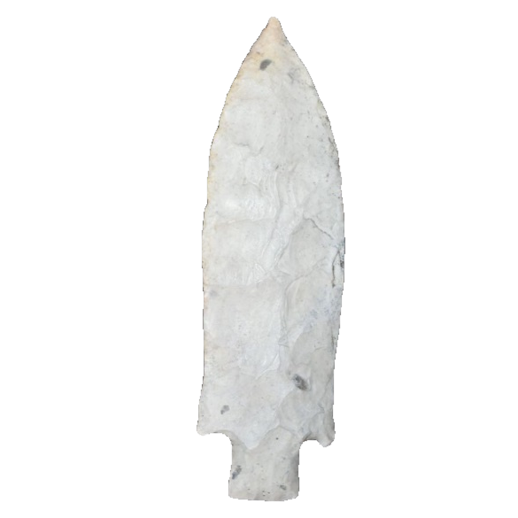
Arrowhead type
Go Kart Point
Go KartEtley Cluster4,000 - 2,500 B.P.Middle Archaic to Late Archaic5 reference photos
Key facts
- Age
- 4,000 - 2,500 B.P.
- Cultural period
- Middle Archaic to Late Archaic
- Size
- Large
- Shape
- Expanding Stem to Contracting Stem to Corner Notch
- Glacial period
- Neoglacial
More from the Archaic period
Description
This substantial, triangular knife boasts a broad blade with a stem that widens towards its base. In cross-section, the blade's profile can vary from a flattened to a more elliptical shape. The blade's curvature is characterized by a range of forms, from excurvate to outwardly recurvate, with the maximum width typically occurring at the blade's upper portion, tapering downwards from this point. The shoulders of the blade may exhibit a pronounced flare, contributing to its recurvate shape, and can range from barbed to angled upwards. Notably, the shoulder morphology can be influenced by the extent of re-sharpening the point has undergone. The stem is generally short, with a shape that can vary from expanding to slightly contracting. The base of the point can display a subtle convexity or concavity. The flaking pattern observed on this artifact is random, lacking a discernible order or orientation.
Size
The dimensions of the arrowheads are as follows: they range in overall length from 76 to 279 mm, with stem lengths spanning 10 to 15 mm. The barb lengths vary between 6 and 10 mm. In terms of width, the arrowheads measure between 32 and 60 mm, while the stem widths fall within the 19 to 26 mm range. The thickness of these artifacts is consistently between 10 and 15 mm.
Distribution
This is a blade linked to the Go-Kart location in Illinois. It is mainly discovered in Illinois and extending into Missouri, but may also occur within the Etley distribution.
Additional information
The archaeological specimen in question is a distinctive variation of the Etley point, a type of projectile point that holds significant importance in the study of Native American lithic technology. Although the original text is brief, it provides a crucial starting point for exploring the characteristics and cultural associations of this particular point style.
Notably, the Etley point is a named type of arrowhead that has been identified and classified through rigorous archaeological research. While the provided text does not offer specific details regarding the date, location, or measurements of this variant, a comprehensive understanding of the Etley point can be gleaned from existing literature on the subject. Typically, such points are analyzed in terms of their morphological features, manufacturing techniques, and distribution patterns to shed light on the technological, social, and cultural contexts in which they were produced and used.
Further examination of this Etley point variant could reveal valuable insights into the lives and traditions of the Native American groups who crafted and utilized these tools. By considering the materials, craftsmanship, and functional design of such arrowheads, archaeologists can reconstruct aspects of the technological, subsistence, and cultural practices of these communities. Moreover, the study of projectile points like the Etley variant contributes to a broader understanding of the complex and dynamic histories of Native American societies, highlighting their resourcefulness, adaptability, and rich cultural heritage.
Identified by
- Named by
- Andrew Fortier
- Year
- 1984
- Type site
- Go-Kart Site, Illinois
Similar types
Types that are easy to confuse with the Go Kart point.