
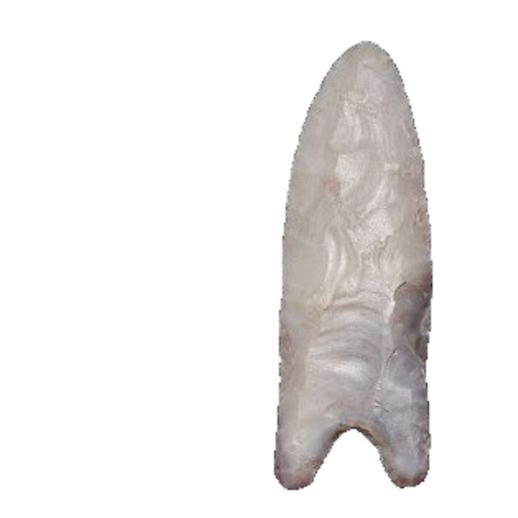
Arrowhead type
Debert Fluted Point
Debert FlutedClovis Cluster11,000 - 9,500 B.P.Late Paleo3 reference photos
Key facts
- Age
- 11,000 - 9,500 B.P.
- Cultural period
- Late Paleo
- Size
- Medium to Large
- Shape
- Auriculate to Lanceolate
- Glacial period
- Late Pleistocene
More from the Paleo period
Description
This lanceolate point exhibits a robust profile, characterized by a medium to large size and a cross-sectional morphology that is distinctly flattened. The blade's curvature is predominantly excurvate, with parallel lateral edges that impart a sense of symmetry. Notably, the point features a sophisticated fluting technique, achieved through the removal of channel flakes and the presence of a pronounced striking nipple. The fluting process has been thoroughly completed, with all remnants of the fluting platform meticulously removed, resulting in a base that is deeply concave.
Size
The dimensions of the arrowheads are characterized by a total length ranging from 50 to 110 mm, a width spanning 20 to 33 mm, and a basal concavity measuring between 6 and 12 mm.
Distribution
This type is mainly discovered in Nova Scotia and extending into New Brunswick. It is also located in eastern parts of New York
Additional information
The classification of Clovis style points has been a topic of ongoing discussion among archaeologists. One perspective suggests that the characteristic features of Clovis points exhibit a consistent range of variation across their geographic distribution, which can be attributed to normal variability within the Clovis type. This viewpoint proposes that the similarities and differences observed among Clovis points are a result of the natural range of variation that occurs within a single point type, rather than indicative of distinct subtypes.
An alternative perspective argues that regional specialization played a significant role in the development of Clovis points, with specific areas exhibiting a higher frequency of certain characteristics. According to this view, these regional variations represent later adaptations and unique subtypes of the Clovis point, which emerged as distinct entities within the broader Clovis tradition. This perspective highlights the importance of considering the spatial and temporal context in which Clovis points were produced and used, as it may reveal patterns of regional specialization and cultural exchange.
Ultimately, the debate surrounding the classification of Clovis points underscores the complexity and diversity of this ancient point style. By examining the variability within the Clovis type and considering the regional and cultural contexts in which they were produced, archaeologists can gain a deeper understanding of the technological, social, and cultural factors that shaped the development of these iconic points. Further research and analysis are needed to fully resolve the question of Clovis point classification, but it is clear that these points continue to hold significant importance for our understanding of the lives and cultures of ancient Native American communities.
Identified by
- Named by
- George F. MacDonald
- Year
- 1968
- Type site
- Debert Site, Nova Scotia, Canada
Similar types
Types that are easy to confuse with the Debert Fluted point.
- Angostura
- Barnes
- Beaver Lake
- Clovis
- Crowfield
- Cumberland
- Dalton
- Holcombe
- Northumberland
Other types in the Clovis Cluster
- Clovis Hazel
- Clovis St Louis
- Clovis Tulare Lake
- Redstone