
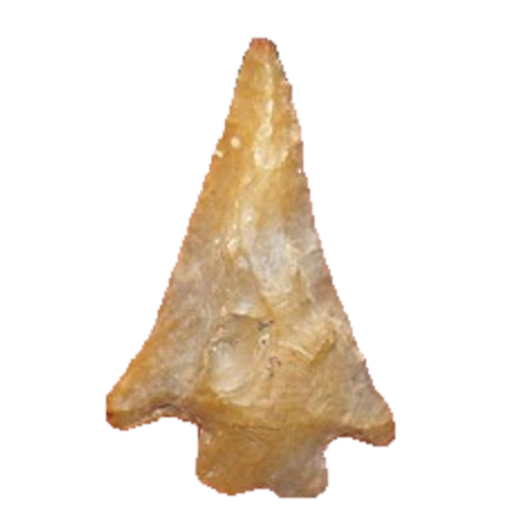
Arrowhead type
Fox Valley Point
Fox ValleyLeCroy Cluster8,200 - 7,800 B.P.Early Archaic15 reference photos
Key facts
- Age
- 8,200 - 7,800 B.P.
- Cultural period
- Early Archaic
- Size
- Small to Medium
- Shape
- Expanding Stem to Straight Stem to Bifurcated
- Glacial period
- Middle Holocene
More from the Archaic period
Description
This triangular point exhibits a slender profile, characterized by an elliptical apex and a predominantly incurvate blade shape, which broadens noticeably at the shoulder margins. In some instances, the blade assumes a straight configuration. Serrations may be present along the blade's edge. The shoulders often display asymmetry, with their orientation varying from horizontal to barbed, frequently curving upward toward the distal terminus. The stem is concise, narrow, and expands slightly, terminating in a bifurcated base. The flaking pattern on this point is random, lacking a discernible order or arrangement.
Size
The dimensions of the arrowheads are characterized by the following measurements: overall length ranges from 24 to 50 mm, with a mean length of 38 mm. The stem measures between 9 and 13 mm in length. The maximum blade width, observed at the shoulders, varies from 19 to 35 mm, averaging 28 mm. The neck width spans 9 to 14 mm, while the stem width ranges from 11 to 16 mm. The thickness of the arrowheads falls within the range of 3 to 7 mm.
Distribution
These artifacts are mainly discovered in the Fox River Valley spanning Wisconsin and Illinois, and extending into the Wabash River valley of Indiana, as well as parts of Illinois and Ohio. They can also appear in other notable areas, albeit less commonly.
Also found, less often, in
Additional information
In the Fox River Valley, a particular type of arrowhead is predominantly found, which has been identified as a distinct variant. Notably, this point bears a strong resemblance to the Lake Erie point, but with a notable difference - it features an exhausted blade. This characteristic has led researchers to categorize it as a unique entity within the realm of Native American arrowheads. The University of Minnesota has grouped this point, along with others, into the Fox Valley Cluster, a classification that excludes the traditional Lake Erie point but includes the MacCorkle point.
Further examination of this cluster reveals that it has been subject to varying interpretations by different scholars. For instance, Justice, in a 1987 publication, refers to this group as the LeCroy cluster, which encompasses the Lake Erie point. In contrast, the MacCorkle point is assigned to a separate category, known as the Rice Lobbed Cluster, highlighting the complexities and nuances involved in the classification of these ancient artifacts. These differing perspectives underscore the ongoing efforts to refine our understanding of the cultural and historical contexts in which these arrowheads were crafted and utilized.
The Fox Valley Cluster, as defined by the University of Minnesota, provides a valuable framework for understanding the technological and stylistic developments of Native American arrowheads in the region. By examining the characteristics of this cluster, including the exhausted blade variant, researchers can gain insights into the lives and traditions of the indigenous peoples who created these artifacts. The study of these arrowheads offers a unique window into the past, allowing us to appreciate the ingenuity, craftsmanship, and cultural diversity of Native American communities, while also acknowledging the complexities and challenges inherent in interpreting the archaeological record.
Identified by
- Named by
- Robert Ritzenthaler, Charles Palmer, and Harris Palmer
- Year
- 1961
Similar types
Types that are easy to confuse with the Fox Valley point.
- Fredrick
- Garth Slough
- Jude
- Kanawha
Other types in the LeCroy Cluster
- Lake Eerie
- LeCroy