
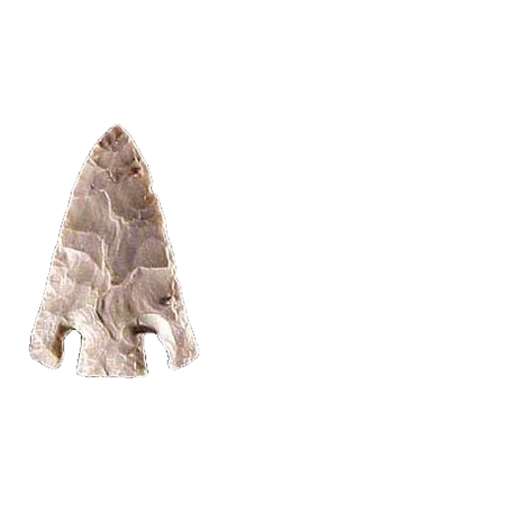
Arrowhead type
Bell Point
Bell8,000 - 5,500 B.P.Developmental to Historic6 reference photos
Key facts
- Age
- 8,000 - 5,500 B.P.
- Cultural period
- Developmental to Historic
- Size
- Small to Medium
- Shape
- Basal Notch
- Glacial period
- Middle Holocene
More from the Developmental, Historic periods
Description
This triangular basal notch point exhibits a distinctive morphology, characterized by an elliptical cross-sectional profile. The blade's curvature can range from gently excurvate to straight, with larger specimens often displaying a more pronounced excurvate shape. The shoulders are marked by robust barbs that extend to the base, frequently curving inward in a distinctive manner. However, re-sharpening can result in shorter barbs. The base of the point is typically straight, although it may exhibit a slight expansion, and its curvature can vary from slightly concave to slightly convex. The flaking pattern on this point is random, lacking a discernible pattern or orientation.
Size
The arrowheads exhibit a range of dimensions, with overall lengths spanning 40 to 100 mm, and a mean length typically falling between 55 and 65 mm. The stem, a crucial component, measures 8 to 15 mm in length. In terms of width, the blade ranges from 30 to 47 mm, while the stem width is consistently between 15 and 20 mm.
Distribution
This type is mainly located in the heart of Texas.
Mainly found in
Additional information
In the realm of Native American arrowheads, a distinct type of point exhibits characteristics that set it apart from others, while also sharing some similarities with notable examples like the Andice point. Notably, these points tend to be smaller in size compared to their Andice counterparts, as observed by Turner and Hester in 1985. A key distinguishing feature lies in the length of the barbs and stem, which are generally shorter in these points. The stem itself is typically straight or slightly expanding, with a base that remains straight, providing a clear point of differentiation.
Upon closer examination, some specimens with shallower notches may bear a resemblance to the Bandy point, highlighting the complexities of classification within the world of arrowhead typology. However, a crucial distinction can be made by examining the stem and base morphology. While Bandy points are characterized by an expanding stem and a concave base, the points in question exhibit a more subdued stem expansion and a straight base. This subtle yet significant difference underscores the importance of meticulous analysis in identifying and categorizing these ancient artifacts.
The study of these points offers valuable insights into the technological and cultural practices of Native American communities, providing a window into the lives and traditions of these ancient societies. By examining the nuances of arrowhead design and morphology, researchers can gain a deeper understanding of the historical context in which these artifacts were created and used. As such, continued research and analysis of these points will undoubtedly shed further light on the complexities of Native American culture and the significance of arrowheads as a testament to their ingenuity and craftsmanship.
Identified by
- Named by
- Harry Shaffer
- Year
- 1967
- Type site
- Landslide Site, Bell County, Texas
Similar types
Types that are easy to confuse with the Bell point.