
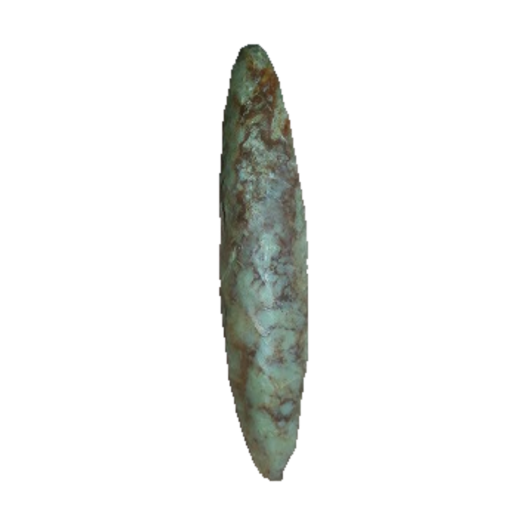
Arrowhead type
Nodena Point
NodenaNodena Cluster600 - 400 B.P.Late Mississippian21 reference photos
Key facts
- Age
- 600 - 400 B.P.
- Cultural period
- Late Mississippian
- Culture
- Quapaw Culture
- Size
- Medium
- Shape
- Ovoid
- Glacial period
- Little Ice Age
More from the Mississippian period
Description
The Nodena point exhibits a robust, ovoid morphology, typically measuring between 1.25 and 2 inches in thickness, with a distinctive elliptical cross-section or a pronounced median ridge. Characterized by a slender, excurvate blade, the point's maximum width is often situated at the midpoint or lower third of the blade. The basal morphology varies between the Nodena Elliptical and Nodena Banks variants, with the former displaying a convex to pointed base that can impart a bi-pointed or teardrop silhouette, while the latter features a straight base. Notably, these points often demonstrate a high level of craftsmanship, fabricated through the removal of thin flakes using fine pressure flaking techniques, resulting in a predominantly random flaking pattern, although some specimens exhibit collateral or oblique transverse flaking.
Size
The dimensions of these arrowheads are characterized by a total length ranging from 30 to 80 mm, with averages of 55 to 65 mm observed for elliptical types and 40 to 50 mm for those classified as Banks. In terms of width, the measurements span from 11 to 25 mm.
Distribution
The most concentrated occurrences are in the southern Arkansas River Valley, St. Francis River Valley, the lower and central Mississippi River basin, and extending into the Illinois River basin and Tennessee River basin. Can also be encountered with lesser regularity in additional noted regions.
Mainly found in
Additional information
In the realm of Native American archaeology, the Quapaw sites in Arkansas have yielded a significant number of distinctive arrowheads. Notably, these points have been previously identified as Willow Leaf points in various older publications and among collectors. To provide a more nuanced understanding, the Nodena Banks Variety has been designated to specifically denote the variant of the Nodena point characterized by its straight base. This distinction was formally established by Justice in 1987, offering a clearer classification for these artifacts and facilitating a more precise understanding of their cultural and historical context.
The Nodena point, with its straight base variant, is a notable example of the diverse range of arrowhead styles crafted by Native American communities. The presence of these points in Quapaw sites underscores the importance of Arkansas as a region for the study of Native American archaeology, particularly in relation to the Quapaw culture. By examining these artifacts, researchers can gain valuable insights into the technological, social, and cultural developments of the communities that created them.
The classification of the Nodena Banks Variety as a distinct subtype highlights the complexity and variability of Native American arrowhead production. This attention to detail is crucial in archaeological research, as it enables scholars to reconstruct the historical and cultural narratives of the regions and communities being studied. Through the careful analysis of artifacts like the Nodena point, researchers can continue to refine their understanding of Native American cultures, ultimately contributing to a more comprehensive and nuanced appreciation of the rich cultural heritage of the region.
Identified by
- Year
- 1955
- Type site
- Nodena Site, eastern Arkansas and the Campbell site, Pemiscot County, Missouri /
Similar types
Types that are easy to confuse with the Nodena point.
Other types in the Nodena Cluster
- Guntherville
- Ichetucknee