
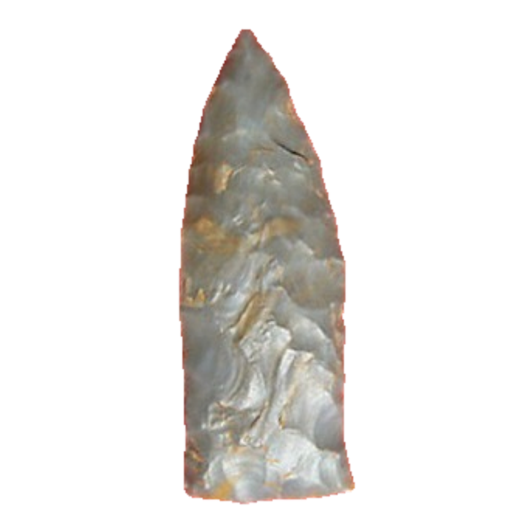
Arrowhead type
Copena Lanceolate Point
Copena LanceolateCopena Cluster4,000- 1,500 B.P.Late Archaic to Early Woodland10 reference photos
Key facts
- Age
- 4,000- 1,500 B.P.
- Cultural period
- Late Archaic to Early Woodland
- Culture
- Copper Burial Mound Culture
- Size
- Medium to Large
- Shape
- Lanceolate
- Glacial period
- Neoglacial to Roman Warm
Description
This lanceolate point exhibits a distinctive morphology, characterized by a medium to large size and an elliptical cross-sectional profile that tapers to a pronounced median ridge. The blade's curvature is notable, transitioning from an outward recurvate to an excurvate shape, a configuration that is accentuated by the constriction of the hafting region. The base of the point is generally straight, although it may display subtle convex or concave deviations, and often features evidence of thinning and light grinding in the hafting area. The flaking pattern on this point is typically broad and shallow, with either a random or collateral arrangement of flakes, while the edges have been meticulously retouched with fine pressure flaking, resulting in a refined and precise finish.
Size
The dimensions of these arrowheads are characterized by a total length ranging from 45 to 130 mm, with an average measurement of 75 mm. The blade width varies between 18 and 40 mm. Notably, the waist width is generally 2 to 5 mm less than the blade width, while the basal width is typically 2 to 5 mm greater than the waist width. In terms of thickness, these arrowheads measure between 7 and 10 mm.
Distribution
This type is mainly located in the Tennessee River Valley. It can also be discovered in the Ohio River Valley, the central Mississippi River valley and the southeastern coastal area
Mainly found in
Also found, less often, in
Additional information
The Copena culture, predominantly found in northern Alabama, is distinguished by its notable burial artifacts, including copper and galena, which ultimately led to the derivation of its name. Characteristic of this culture are the varied arrowhead points, encompassing both functional, everyday tools and larger, more ceremonial pieces, as observed by Justice in 1987. These points exhibit a unique morphology, sometimes resembling other regional styles, such as the Ansell points from Illinois and the Gahagan Knives from Texas. However, despite their visual similarities, these styles are not associated with the Copena Burial culture and are not directly related to the Copena point type.
The geographic distribution of Copena points extends beyond northern Alabama, with a subset of these points found in Southern Georgia and Florida, referred to as the Florida Copena by John Whatley in 2002. Notably, the Copena-type points discovered in this southern region tend to be smaller in size compared to their counterparts found further north. This size variation highlights the complexity and diversity within the Copena point tradition, underscoring the importance of considering regional differences when analyzing these artifacts.
The study of Copena points offers valuable insights into the cultural and technological practices of the societies that created them. By examining the morphology, distribution, and cultural context of these points, researchers can gain a deeper understanding of the social, economic, and symbolic significance of these artifacts within the Copena culture. Furthermore, the comparison of Copena points with other regional styles, such as the Ansell and Gahagan points, can provide a more nuanced understanding of the cultural exchange networks and technological traditions that existed among prehistoric societies in North America.
Identified by
- Named by
- William Webb and David DeJannette
- Year
- 1942
- Type site
- Pickwick Basin, northern Alabama
Similar types
Types that are easy to confuse with the Copena Lanceolate point.
Other types in the Copena Cluster
- Copena Articulated
- Copena Round Base
- Copena Triangular
- Greenville