
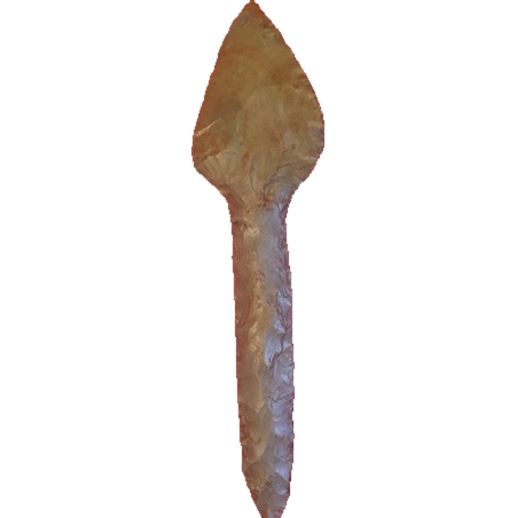
Arrowhead type
Dagger Knife
Dagger Knife4,000 - 1,500 B.P.Late Archaic to Early Woodland12 reference photos
Key facts
- Age
- 4,000 - 1,500 B.P.
- Cultural period
- Late Archaic to Early Woodland
- Size
- Large
- Shape
- Straight Stem
- Glacial period
- Neoglacial to Roman Warm
Description
This substantial stemmed point exhibits a distinctive blade morphology, characterized by a curvature that can vary from excurvate to recurvate, with the apex forming an inward curve that then flares outward at the shoulder region. The shoulders themselves are positioned at an elevated angle, imparting a sense of dynamism to the overall form. In contrast, the stem is relatively diminutive, yet expands gradually, terminating in a convex base. The flaking pattern observed on this point is random, lacking a discernible order or sequence.
Size
Large
Distribution
This style is predominantly linked to Tennessee and extends into Kentucky, yet has also been discovered in Indiana and Alabama.
Also found, less often, in
Additional information
In a notable study published by Hodges in 1911, two significant examples of Native American arrowheads were highlighted. One of these artifacts, discovered in the state of Indiana, measures an impressive 10 inches in length, making it a substantial find. In contrast, the second example, which was unearthed in Alabama, is slightly smaller, with a length of 7 inches. These two arrowheads, differing in size but likely sharing cultural significance, offer valuable insights into the craftsmanship and technological capabilities of Native American communities in these regions during their respective periods of use.
The geographical distribution of these finds, with one in Indiana and the other in Alabama, underscores the extensive reach and diversity of Native American cultures across different parts of North America. The fact that these arrowheads vary in size may indicate differences in their intended use, with the larger example potentially being used for hunting larger game or for ceremonial purposes. The smaller arrowhead, on the other hand, might have been more suited for smaller game or precision hunting.
The study by Hodges, dating back to 1911, demonstrates an early interest in documenting and understanding Native American artifacts. These arrowheads, now over a century since their documentation, continue to serve as important artifacts for archaeologists, providing a window into the lives and traditions of Native American communities. Their preservation and study contribute to a broader understanding of the cultural and technological achievements of these communities, highlighting the sophistication and adaptability of Native American cultures in different regions and time periods.
Identified by
- Named by
- Smithsonian Publications: Fredrick Webb Hodges
- Year
- 1911
Similar types
Types that are easy to confuse with the Dagger Knife point.