
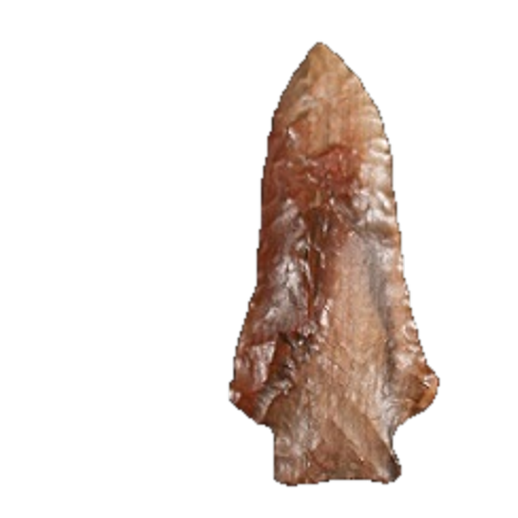
Arrowhead type
Friley Point
Friley1,300 - 900 B.P.Prehistoric to Mississippian30 reference photos
Key facts
- Age
- 1,300 - 900 B.P.
- Cultural period
- Prehistoric to Mississippian
- Culture
- Caddo Culture
- Size
- Small to Medium
- Shape
- Contracting Stem to Expanding Stem to Bifurcated
- Glacial period
- Vandal Minimum to Medieval Warm
More from the Mississippian period
Description
This slender, triangular point features a distinctive elliptical to flattened cross-sectional profile, with a recurvate blade that exhibits a subtle curvature at the tip. The shoulders are notable for their pronounced, upward-angled or rounded morphology, often characterized by an exaggerated flaring that can give the appearance of being "spurred". In many instances, the shoulder edge of the blade becomes horizontal or curves upward, creating a unique visual profile. The stem, which can vary in form, typically ranges from slightly expanding to expanding with a straight or concave base, although some examples may exhibit a contracting stem with a convex base. The overall craftsmanship of this point is often of high quality, with a random flaking pattern that suggests a deliberate and skilled manufacturing process.
Size
The arrowhead's dimensions are characterized by a total length ranging from 20 to 35 mm. The stem, which forms the base of the arrowhead, measures between 3 to 7 mm in length. In terms of width, the maximum blade width spans 12 to 25 mm, while the neck, the narrowed section above the stem, has a width of 4 to 8 mm. The stem itself has a width of 7 to 12 mm.
Distribution
This type is mainly discovered in Natchitoches Parish of northwest Louisiana and extending into east Texas. It can also be located in southwest Arkansas and southeast Oklahoma
Additional information
In the realm of Native American archaeology, a specific type of arrowhead has been identified and categorized based on its geographical distribution. Notably, these artifacts are frequently found on Gem Island in Louisiana, which has led to their colloquial designation as "Gem" or "Jim" points. This nomenclature is attributed to the observations of Perino, who documented this phenomenon in 1985. The prevalence of these arrowheads on Gem Island suggests a significant cultural presence in this region, highlighting the importance of this location in the study of Native American archaeology.
The association of these arrowheads with Gem Island provides valuable insights into the cultural and geographical contexts of Native American communities in Louisiana. The fact that Perino's research in 1985 recognized the high occurrence of these points on the island underscores the significance of this site in understanding the archaeological record of the region. By examining the distribution and characteristics of these arrowheads, researchers can glean information about the technological, social, and cultural practices of the Native American groups that inhabited this area.
The designation of these arrowheads as "Gem" or "Jim" points serves as a testament to the importance of Gem Island as a hub of Native American activity. Further study of these artifacts and their context can provide a more nuanced understanding of the lives and traditions of the indigenous peoples who created and utilized them. As such, continued research into the archaeology of Gem Island and its associated artifacts remains a vital pursuit, offering a window into the past and shedding light on the complex cultural heritage of Native American communities in Louisiana.
Identified by
- Named by
- Clarence H. Webb, Hiram F. Gregory, and Robert E. Bell
- Year
- 1963
- Type site
- The Friley Site, Natchitoches Parish, Louisiana
Similar types
Types that are easy to confuse with the Friley point.
- Bayougoula
- Cuney
- Edwards
- Morris
- Penwah Slough
- Steiner
Other types in this cluster
- Friley Blade