
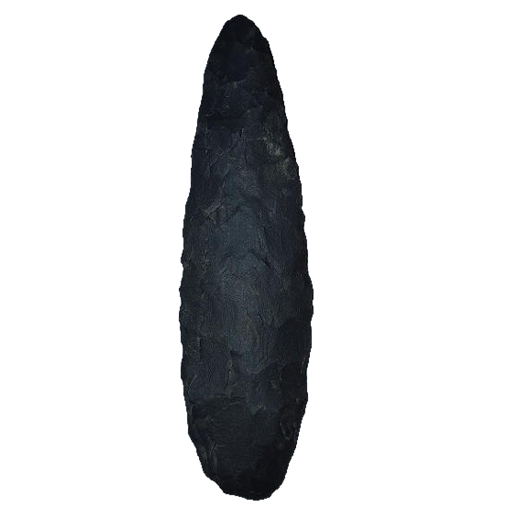
Arrowhead type
Embarras Bi-Point
Embarras Bi-Point7,000 - 4,000 B.P.Transitional Paleo to Middle Archaic3 reference photos
Key facts
- Age
- 7,000 - 4,000 B.P.
- Cultural period
- Transitional Paleo to Middle Archaic
- Size
- Medium to Large
- Shape
- Ovoid
- Material
- Basalt
- Glacial period
- Middle Holocene to Neoglacial
Description
The specimen exhibits a substantial, ovoid morphology, characterized by an elliptical cross-sectional profile. Its excurvate shape is marked by a pronounced widening at the midpoint, resulting in a distinctive curvature. The blade's width can vary significantly, ranging from a slender, bi-pointed form to a broader, more ovoid silhouette. The flaking pattern observed on this artifact is random, with evidence of pressure flaking employed to refine the edges, suggesting a deliberate and controlled technique in its manufacture.
Size
The dimensions of the arrowheads are as follows: they range in length from 69 to 142 millimeters, in width from 35 to 69 millimeters, and in thickness from 8 to 25 millimeters.
Distribution
These artifacts are mainly linked to the Embarras Plateau of Alberta and across the Rocky Mountains of British Columbia, stretching into Idaho and Montana. The complete range remains unclear and may possibly reach into Washington and Saskatchewan
Also found, less often, in
Additional information
In the realm of Native American arrowheads, a common point of confusion arises between certain styles and their chronological counterparts, particularly with regards to the Cascade points. It is essential to note that these specific points are not culturally affiliated with the Old Cordilleran Culture, a distinction that aids in their proper identification and dating. Interestingly, archaeological findings along the coastal regions of British Columbia have uncovered a similar point, known as the Xil Projectile Point, which has been extensively studied by researchers such as Fedje et al. in 2008. Notably, radiocarbon dating has revealed that the Xil Projectile Point is significantly older, with age estimates ranging from 8,800 to 8,700 years Before Present (B.P.), as corroborated by Row in 2008. This substantial age difference underscores the importance of precise identification and dating of archaeological artifacts to reconstruct an accurate picture of the cultural and technological developments of Native American communities.
Identified by
- Named by
- David Meyer
- Year
- 2003
- Type site
- FgQf-62 and FgQf-16 Alberta, Canada
Similar types
Types that are easy to confuse with the Embarras Bi-Point point.