
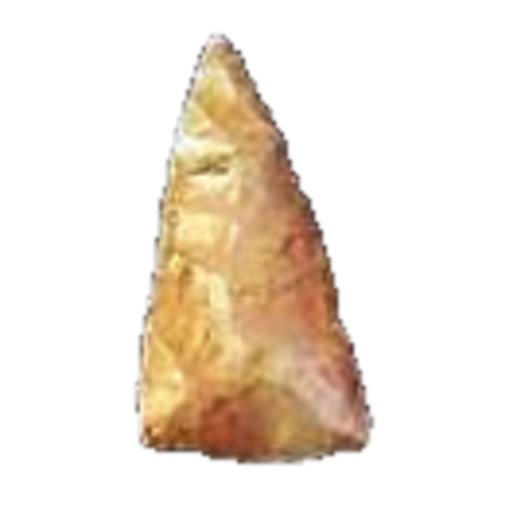
Arrowhead type
Buck Garden Triangle Point
Buck Garden TriangleLate Woodland Triangle Cluster to Early Mississippian Triangle Cluster1,600 - 1,300 B.P.Woodland2 reference photos
Key facts
- Age
- 1,600 - 1,300 B.P.
- Cultural period
- Woodland
- Culture
- Buck Garden Culture
- Size
- Small
- Shape
- Triangle
- Glacial period
- Little Ice Age to Modern Times
More from the Woodland period
Description
This slender, triangular point measures between 0.5 and 0.75 inches in thickness and exhibits a flattened cross-sectional profile. The blade's longitudinal axis is characterized by a predominantly straight to subtly excurvate morphology. In terms of overall shape, the point typically assumes an isosceles triangular form, where the width is approximately half the height, although some specimens may display an equilateral triangular configuration, with width and height being roughly equivalent. The basal edge is generally straight, occasionally featuring a slight concavity. The flaking pattern appears to be irregular and non-directional, often displaying a coarse, unrefined quality, suggestive of expedient manufacture.
Size
Small
Distribution
This type is linked to the Buck Garden Phase locations, which are seldom discovered beyond the Gauley River basin in West Virginia (Applegate and Mainford, 2005).
Mainly found in
Also found, less often, in
Additional information
The Buck Garden projectile points are a distinctive type of arrowhead associated with the Buck Garden ceramics, a cultural phenomenon that emerged in the region. Characterized by their side-to-corner notch or triangular shape, these points are often crudely manufactured, as noted by McMichael in his 1963 study. Further research by McMichael in 1965 revealed that the Buck Garden Culture developed from the earlier Armstrong culture, shedding light on the evolutionary trajectory of this ancient society.
The Buck Garden Culture is named after the archaeological site located on Buck Garden Creek in Nicholas County, West Virginia, where numerous examples of these points were unearthed. Dating back to the Buck Garden Cultural period, which spanned from 500 to 1200 years before present, these points represent a unique variant of the triangular projectiles that were widespread across the eastern half of the continent during the Woodland and Mississippian periods. This phenomenon is not isolated, as similar point types have been found at other sites, such as Garden Creek, highlighting the cultural exchange and technological diffusion that occurred during this time.
As highlighted in McMichael's 1968 publication, "Introduction to West Virginia Archeology," the Buck Garden points are an important part of the region's archaeological record, offering valuable insights into the lives and traditions of the indigenous peoples who inhabited the area. The study of these points, in conjunction with other archaeological findings, provides a more comprehensive understanding of the cultural and technological developments that took place in the region during the Woodland and Mississippian periods, ultimately enriching our knowledge of Native American history and cultural heritage.
Identified by
- Named by
- Edward V. McMichaels
- Year
- 1965
- Type site
- Buck Garden Creek, Nicholas County, West Virginia