
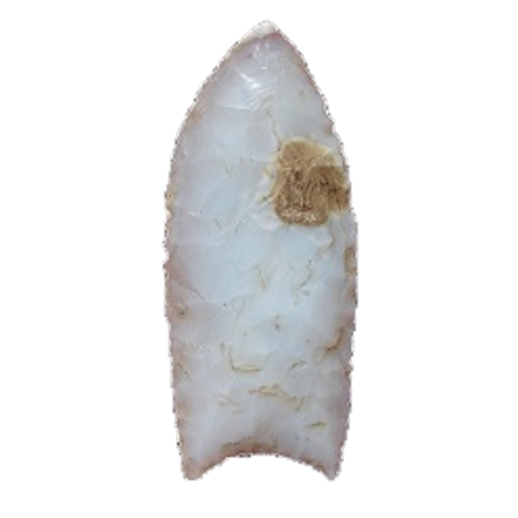
Arrowhead type
Black Rock Concave Point
Black Rock ConcavePlano Lanceolate Cluster11,000 - 9,000 B.P.Transitional PaleoKey facts
- Age
- 11,000 - 9,000 B.P.
- Cultural period
- Transitional Paleo
- Size
- Medium
- Shape
- Lanceolate
- Material
- Obsidian
- Glacial period
- Late Pleistocene to Early Holocene
More from the Paleo period
Description
This medium-sized lanceolate point exhibits a slender profile with a compressed cross-sectional shape. Its blade features an excurvate morphology, characterized by an initial outward curve that straightens around the midpoint, and in some instances, continues parallel to the base, while in others, it curves inward again towards the base. The basal edge is distinctly concave. The point's manufacture involves pressure flaking, which achieves a thin, refined blade shape, accompanied by basal thinning through the removal of short, vertical flakes that extend into the hafting area. Additionally, subtle basal grinding may be observed. The flaking pattern on this point is marked by a predominantly horizontal to parallel transverse or random arrangement, showcasing the skillful application of pressure flaking techniques.
Size
The dimensions of the arrowheads are characterized by a total length range of 30 to 95 millimeters. The maximum width of the blade varies between 17 and 32 millimeters. Additionally, the basal concavity measures between 3 and 5 millimeters, while the thickness of the arrowhead ranges from 4 to 6 millimeters.
Distribution
This type is mainly discovered in the Black Rock Desert, yet has also been located throughout the Great Basin.
Mainly found in
Also found, less often, in
Additional information
The chronology of the Black Rock point has been a subject of debate among archaeologists. Radiocarbon dating at various sites has yielded results suggesting a transitional Paleo period affiliation, a notion further supported by Obsidian hydration readings. However, an alternative perspective, proposed by Jennings in 1986, positions the Black Rock point within the concave basal series, alongside the Humboldt point, which would place it in the middle to late Archaic period. This discrepancy is notable, as excavations at Hogup Cave have uncovered Black Rock points in the same stratigraphic layer as Humboldt points, potentially indicating a contemporaneous presence.
Nevertheless, Justice's 2002 analysis highlights the complexity of this issue, suggesting that the Hogup Cave site may have experienced cultural admixture, as evidenced by the co-occurrence of Desert Side Notch points in the same stratum. Similarly, at Danger Cave, Black Rock-type points were found in association with Humboldt points, yet Justice argues that these points do not conform to the established typology of either Black Rock or Humboldt points. This anomaly may be contributing to the uncertainty surrounding the dating of the Black Rock point, underscoring the need for continued research and refinement of our understanding of this point's cultural and temporal context.
The presence of Black Rock points at multiple sites, including Hogup Cave and Danger Cave, alongside other point types, underscores the complexity of cultural exchange and technological evolution during the Paleo and Archaic periods. As archaeologists, it is essential to consider the potential for site-specific admixture and the limitations of typological classifications in resolving the chronology of specific point types. By acknowledging these challenges and continuing to integrate new data and perspectives, we can work towards a more nuanced understanding of the Black Rock point and its place within the broader narrative of Native American cultural development.
Identified by
- Named by
- C. W. Clewlow Jr.
- Year
- 1968
Similar types
Types that are easy to confuse with the Black Rock Concave point.