
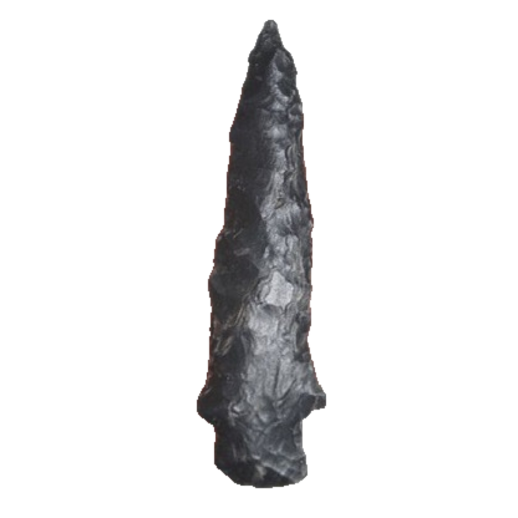
Arrowhead type
Big Valley Point
Big ValleyBig Valley Cluster6,000 - 4,000 B.P.Middle Archaic to Late Archaic3 reference photos
Key facts
- Age
- 6,000 - 4,000 B.P.
- Cultural period
- Middle Archaic to Late Archaic
- Size
- Medium to Large
- Shape
- Straight Stem
- Glacial period
- Middle Holocene to Neoglacial
More from the Archaic period
Description
This triangular point exhibits a medium to large size, characterized by an elliptical cross-sectional profile. The blade morphology is predominantly excurvate, although variations occur, including triangular forms and examples with converging sides that become parallel towards the apex. Serrations are a common feature, ranging from fine to deep, with the latter often associated with re-sharpened blades. The shoulder orientation is variable, spanning from horizontal to upwardly angled, and tends to become less pronounced as the blade undergoes repeated re-sharpening. The stem is distinguished by an expanding form, terminating in a base that is either straight or slightly convex. The flaking pattern observed on this point is random, lacking a discernible order or arrangement.
Size
The dimensions of the arrowheads are as follows: they range in overall length from 28 to 115 mm, with stem lengths varying between 10 and 17 mm. The width of the blade spans from 22 to 34 mm, while the stem width at the shoulders measures between 15 and 23 mm. Additionally, the basal width falls within the range of 20 to 24 mm, and the thickness of the arrowheads is between 6 and 12 mm.
Distribution
This projectile is mainly located in the northern coastal mountains of California. This projectile can also be discovered in the southern Cascades, albeit with lesser occurrence.
Mainly found in
Additional information
In the realm of Native American archaeology, a particular type of arrowhead is commonly associated with the Middle Archaic period, which spanned from approximately 6,000 to 5,500 years before present. According to Justice (2002), this point style is not believed to have persisted beyond 3,500 years before present. A distinctive characteristic often linked with this type of point is the presence of barbed shoulders. However, it is worth noting that examples featuring barbed shoulders are more typically representative of the Kelsey Barbed type, which is a distinct category. As a result, the absence of barbed shoulders in the description of this Middle Archaic point is not unusual, and instead, highlights the nuances of classification within the realm of arrowhead typology.
The Middle Archaic period is marked by significant cultural and technological developments, and the study of arrowheads from this era provides valuable insights into the lives and traditions of Native American communities. The specific characteristics of arrowheads, including shoulder morphology, can be crucial in determining their cultural affiliation and chronological placement. In this case, the point in question is thought to have been crafted during a time of notable cultural and environmental change, and its study contributes to a deeper understanding of the complexities of Native American prehistory.
The distinction between this Middle Archaic point and the Kelsey Barbed type underscores the importance of careful analysis and classification in archaeology. By recognizing the subtle differences between various point styles, researchers can reconstruct a more accurate and detailed picture of the past, including the technological, social, and cultural contexts in which these artifacts were created and used. As such, the study of Native American arrowheads continues to be an essential component of archaeological inquiry, offering a unique window into the history and traditions of indigenous cultures.
Identified by
- Named by
- Noel Justice
- Year
- 2002
Similar types
Types that are easy to confuse with the Big Valley point.
Other types in the Big Valley Cluster
- Cache Creek Corner Notch
- Kelsey Creek Barbed
- Mayacmas Corner Notch