
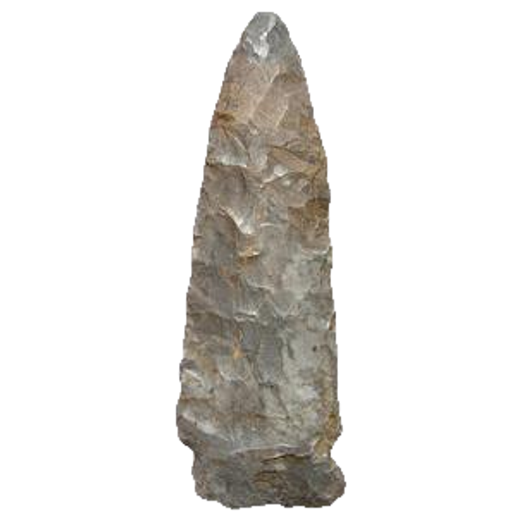
Arrowhead type
Mayacmas Point
MayacmasBig Valley Cluster4,500 - 2,500 B.P.Middle Archaic to Late Archaic3 reference photos
Key facts
- Age
- 4,500 - 2,500 B.P.
- Cultural period
- Middle Archaic to Late Archaic
- Size
- Medium to Large
- Shape
- Corner Notch to Side Notch
- Glacial period
- Neoglacial
More from the Archaic period
Description
This triangular point exhibits a distinctive morphology, characterized by a medium to large size and a side-to-corner notch configuration. Its cross-sectional profile is elliptical, while the blade itself can display a range of curvature, from straight to excurvate. Serrations are a common feature along the blade's edge. The shoulders of this point are typically subtly barbed, although they can also appear horizontal. Notably, extensive re-sharpening can alter the shoulder morphology, resulting in a reduced profile that may impart an upward-angled appearance. The diagonal notches, which originate from the corner of the preform, can be deep, but tend to become shallower as the point undergoes repeated re-sharpening. The stem expands downward, terminating in a base that can be straight or slightly convex. The flaking pattern on this point is often random, but can also exhibit a more organized chevron pattern, highlighting the variability in its manufacture.
Size
The dimensions of the arrowheads are as follows: they range in overall length from 34 to 76 mm, with stem lengths varying between 9 and 14 mm. The width of the blade spans from 24 to 73 mm, while the neck width measures between 14 and 24 mm. The basal width falls within the range of 15 to 27 mm, and the thickness of the arrowheads is between 7 and 10 mm.
Distribution
This type is mainly located in the northern coastal mountains of California. It can also be discovered, albeit less often, in the southern Cascade range and northern Sierra Nevada region
Mainly found in
Additional information
In the realm of Native American archaeology, the Mayacmas Side Notch point is a notable example of a medium-sized projectile and knife, typically measuring between 2 1/2 and 3 inches in length. Characterized by its narrow shape and round basal corners, this point features a short stem and horizontal shoulders, which can be either barbed or rounded. The edges of the Mayacmas Side Notch point often exhibit serration, a distinctive trait that sets it apart from other types. Initially identified by Noel Justice, this point was named after its discovery in the Mayacmas Mountains near Clear Lake, a region that has yielded numerous significant archaeological finds.
The Mayacmas Side Notch point is considered a variant of the Big Valley type, with a distribution that spans the Great Basin region. This classification is significant, as it highlights the point's connection to a broader cultural and geographical context. The Great Basin region, which encompasses parts of modern-day California, Nevada, and other surrounding areas, was home to a diverse range of Native American groups, each with their own unique cultural and technological traditions. The Mayacmas Side Notch point is believed to have been in use during the Middle Archaic period, a time of significant cultural and technological development in the region.
As documented by Noel Justice in his comprehensive work, "Stone Age Spear and Arrow Points of California and the Great Basin" (2002), the Mayacmas Side Notch point is an important example of the region's rich archaeological heritage. Justice's research has shed light on the complexities of Native American technology and culture in the Great Basin region, and the Mayacmas Side Notch point is a notable addition to this body of knowledge. By examining the characteristics and distribution of this point, archaeologists can gain a deeper understanding of the cultural and technological dynamics at play in the region during the Middle Archaic period, and how these factors contributed to the development of Native American societies in the Great Basin.
Identified by
- Named by
- Noel Justice
- Year
- 2002
Similar types
Types that are easy to confuse with the Mayacmas point.
Other types in the Big Valley Cluster
- Big Valley Stemmed
- Cache Creek Notched
- Kelsey Creek Barbed