
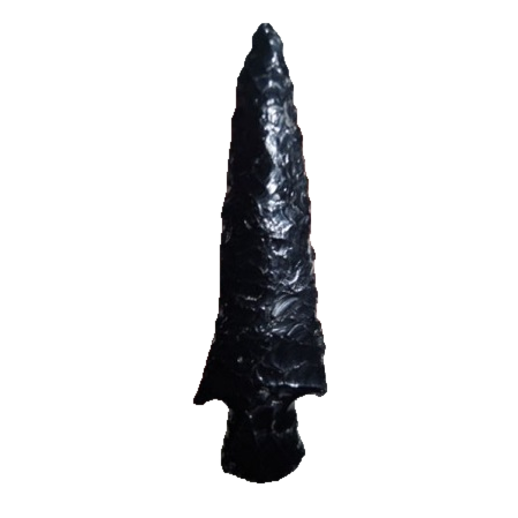
Arrowhead type
Kelsey Creek Point
Kelsey CreekBig Valley Cluster6,000 - 4,500 B.P.Middle Archaic to Late Archaic2 reference photos
Key facts
- Age
- 6,000 - 4,500 B.P.
- Cultural period
- Middle Archaic to Late Archaic
- Size
- Medium to Large
- Shape
- Expanding Stem to Side Notch to Corner Notch
- Glacial period
- Middle Holocene to Neoglacial
More from the Archaic period
Description
This triangular point exhibits a distinctive morphology, characterized by a medium to large size and an elliptical cross-sectional profile. The blade edge can range from straight to excurvate, while heavily resharpened specimens may display a recurvate shape. The shoulders typically feature barbed morphology, although this characteristic can be diminished in examples that have undergone extensive resharpening. The stem is notable for its expanding form and generally lengthy proportions, with a narrow neck that can vary in width depending on the placement of notches. The basal edge can exhibit a range of shapes, from straight to slightly convex. The flaking pattern on this point is random, lacking a consistent or organized arrangement of flake scars.
Size
The dimensions of the arrowheads are as follows: they range in overall length from 28 to 87 mm, with stem lengths varying between 13 and 19 mm. The width of the blade spans from 24 to 40 mm, while the stem width at the shoulders measures between 10 and 17 mm. Additionally, the basal width falls within the range of 14 to 21 mm, and the thickness of the arrowheads is between 6 and 12 mm.
Distribution
This type is mainly located in the northern coastal mountains of California. It can also be discovered in the southern Cascades, albeit with less regularity.
Mainly found in
Additional information
The geographic distribution of this particular arrowhead type remains somewhat enigmatic, with its precise range not yet fully delineated. Nevertheless, archaeological findings have consistently shown that it is predominantly found throughout the northern coastal regions of California. Additionally, its presence has been documented as far north as southern Oregon, although this overlap with the smaller, more recently identified Trinity Barbed point can lead to challenges in distinguishing between the two types. As noted by Justice in 2002, this overlap complicates our understanding of the distribution patterns, highlighting the need for further research to clarify the boundaries of this point's geographic range.
It is worth noting that the northern coastal ranges of California provide a unique cultural and environmental context, with various Native American groups having inhabited this region for thousands of years. The presence of this arrowhead type within this region may offer valuable insights into the technological, social, and economic dynamics of these ancient cultures. Further study of the distribution and characteristics of this point, as well as its relationship to other artifact types, such as the Trinity Barbed point, can contribute significantly to our understanding of the prehistory of this region.
The distinction between this point and the Trinity Barbed point is crucial, as it may have implications for our understanding of the cultural and chronological contexts in which they were used. By examining the morphological characteristics, manufacturing techniques, and spatial distribution of these points, researchers can work towards a more nuanced understanding of the lives and traditions of the Native American groups who created and utilized them. Ultimately, a more comprehensive knowledge of the distribution and characteristics of this arrowhead type will enhance our appreciation of the rich cultural heritage of the region and provide a more detailed picture of the lives of its ancient inhabitants.
Identified by
- Named by
- Noel Justice
- Year
- 2002
Similar types
Types that are easy to confuse with the Kelsey Creek point.
Other types in the Big Valley Cluster
- Big Valley Stemmed
- Cache Creek Notched
- Mayacmas Notched