
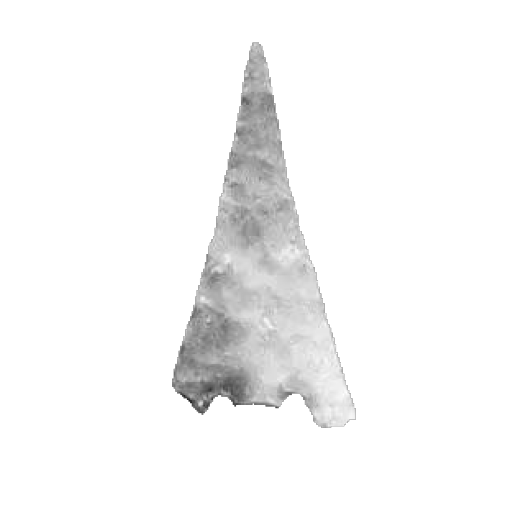
Arrowhead type
Dolores Point
DoloresDolores Cluster1,400 - 1,000 B.P.Developmental9 reference photos
Key facts
- Age
- 1,400 - 1,000 B.P.
- Cultural period
- Developmental
- Culture
- Anasazi Culture
- Size
- Small
- Shape
- Straight Stem to Basal Notch
- Glacial period
- Vandal Minimum to Medieval
More from the Developmental period
Description
This triangular stemmed point exhibits a distinctive morphology, characterized by a flattened cross-sectional profile. The blade's longitudinal axis is predominantly straight, although it can occasionally exhibit a subtle incurvate curvature, accompanied by a pronounced flaring at the shoulder's edge. Notably, the shoulders are adorned with strong barbs. The stem's configuration can vary, ranging from a straight alignment to a more expansive form. Similarly, the base of the point can display a range of shapes, from a straight edge to a mildly convex curvature. The flaking pattern observed on this point is random, lacking a discernible or consistent pattern.
Size
The arrowheads exhibit a range of dimensions, with total lengths spanning 15 to 60 mm, and averaging between 25 to 35 mm. The stem itself measures 4 to 9 mm in length, while the blade width varies from 11 to 30 mm. In terms of stem dimensions, the width ranges from 3 to 8 mm. For those with an expanding stem, the basal width is between 5 to 14 mm. The overall thickness of the arrowheads falls within a range of 3 to 7 mm.
Distribution
This type is mainly discovered in regions linked to Ancestral Puebloan locations. This type may be discovered on the Colorado Plateau up to the Uinta Mountain range and southward to the Su Site of New Mexico and westward to Navajo Mountain
Mainly found in
Additional information
In the realm of Native American arrowhead typology, the Dolores Expanding Stem bears a notable resemblance to the Abajo type, with a key distinguishing characteristic being the relative length of their stems. A closer examination reveals that the Abajo type is distinct in having a stem that is longer in proportion to the rest of the arrowhead. This subtle yet significant difference underscores the importance of meticulous analysis in identifying and categorizing these ancient artifacts. By recognizing such variations, archaeologists can gain a deeper understanding of the technological and cultural developments of the indigenous peoples who crafted these tools.
The Dolores Expanding Stem and Abajo types are both significant finds in the archaeological record, offering insights into the lives and traditions of Native American communities. While the Dolores Expanding Stem has its own unique characteristics, its similarity to the Abajo type highlights the complexity and diversity of arrowhead designs across different regions and cultures. The study of these artifacts not only sheds light on the technological prowess of their creators but also provides a window into the social, economic, and environmental contexts in which they were used.
Through the comparative analysis of arrowhead types like the Dolores Expanding Stem and the Abajo, researchers can reconstruct a more nuanced narrative of Native American cultural and technological evolution. By examining the variations in stem length, blade shape, and other features, archaeologists can trace the development of distinct regional styles and the exchange networks that facilitated the spread of ideas and innovations. This, in turn, enriches our understanding of the rich cultural heritage and the remarkable adaptability of Native American communities, underscoring the value of continued research and exploration into the history and significance of these enigmatic artifacts.
Identified by
- Named by
- Carl Phagan
- Year
- 1988
- Type site
- The Dolores Archaeological Program
Similar types
Types that are easy to confuse with the Dolores point.