
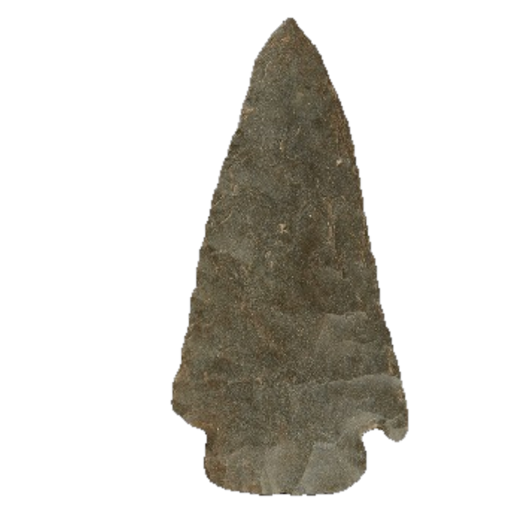
Arrowhead type
Big Slough Point
Big Slough7,000 - 4,000 B.P.Middle Archaic14 reference photos
Key facts
- Age
- 7,000 - 4,000 B.P.
- Cultural period
- Middle Archaic
- Size
- Medium to Large
- Shape
- Expanding Stem
- Material
- Limestone
- Glacial period
- Middle Holocene to Neoglacial
More from the Archaic period
Description
This expansive stemmed point exhibits a medium to large size, characterized by an elliptical cross-sectional profile, which may be accentuated by a median ridge on one or both lateral surfaces. The blade morphology varies, with newer specimens displaying an excurvate shape, while re-worked examples often exhibit an outward recurvate and asymmetrical form. The shoulder morphology ranges from straight to barbed, occasionally featuring a subtle upward inclination, particularly in re-worked points. The stem expands downward, terminating in a convex base that imparts a bulbous appearance. Basal grinding or thinning may be present, modifying the base. Flaking patterns on this point are typically random, although some specimens may display collateral flaking on the faces, often accompanied by a median ridge.
Size
The arrowheads exhibit the following dimensional characteristics: their overall length ranges from 49 to 85 mm, with a mean length of 62 mm. The stem portion measures between 14 and 17 mm in length, averaging 15 mm. The blade width varies from 29 to 42 mm, with an average width of 29 mm. In terms of stem width, the measurements fall within the 20 to 28 mm range, averaging 25 mm. The thickness of the arrowheads is between 7 and 9 mm.
Distribution
These artifacts are mainly located in the Upper Mississippi, Northeastern Alabama, Northwestern Georgia, and extending into Tennessee and Kentucky (Tennessee River Valley). They can also be discovered with decreased regularity in the Ohio River Valley and throughout the central Mississippi River Valley
Additional information
In the realm of Native American arrowhead typology, a particular point style is frequently misconstrued with other similar forms. Notably, the Boggy Branch I and Boggy Branch II points, which are characterized by a more pronounced, bulbous base, are often confused with this point. These Boggy Branch points are predominantly found in the Gulf region, showcasing distinct geographical associations. Furthermore, the Ferry point, which is prevalent in the Ohio River Valley, also bears a resemblance to this point, highlighting the complexities of arrowhead classification across different cultural and geographical contexts.
A closer examination of the characteristics and distributions of these point styles reveals subtle yet significant differences. The bulbous base of the Boggy Branch I and II points, for instance, serves as a distinguishing feature, setting them apart from other point styles. In contrast, the Ferry point, found in the Ohio River Valley, exhibits a unique combination of traits that are adapted to the regional cultural and environmental factors. By recognizing and understanding these variations, archaeologists can gain valuable insights into the technological, social, and cultural practices of Native American groups across different regions.
The correct identification and classification of these point styles are crucial for reconstructing the cultural and historical narratives of Native American communities. By acknowledging the similarities and differences between these points, researchers can better comprehend the complex dynamics of cultural exchange, technological innovation, and geographical adaptation that shaped the lives of indigenous peoples in North America. Ultimately, a nuanced understanding of these arrowhead styles contributes to a richer and more detailed appreciation of the diverse cultural heritage of Native American societies.
Identified by
- Named by
- James Cambron and David Hulse
- Year
- 1960
- Type site
- Hulse Site, Limestone County, Alabama
Similar types
Types that are easy to confuse with the Big Slough point.