
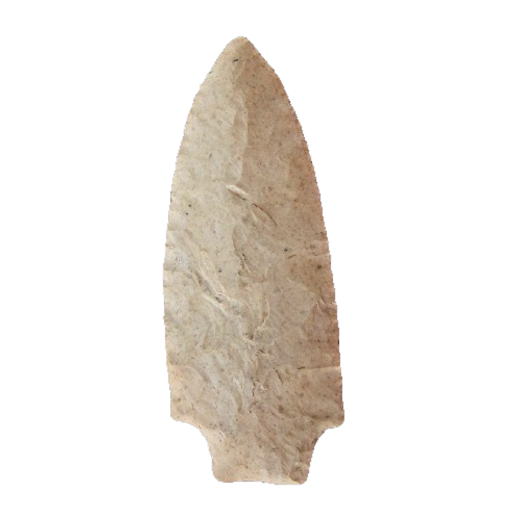
Arrowhead type
Benton Stemmed Point
Benton StemmedBenton Stemmed Cluster6,000 - 4,000 B.P.Middle Archaic20 reference photos
Key facts
- Age
- 6,000 - 4,000 B.P.
- Cultural period
- Middle Archaic
- Size
- Medium to Large
- Shape
- Expanding Stem to Straight Stem to Contracting Stem
- Glacial period
- Middle Holocene
More from the Archaic period
Description
This expanding stemmed point exhibits a size range of medium to very large, typically measuring 2.75 inches or more in length. Its cross-sectional profile is characterized by an elliptical to flattened shape. The blade itself is marked by an excurvate curvature and often features beveled edges. The shoulders of the point are subtly defined, with an orientation that can vary from horizontal to upwardly angled. The stem is notably broad, with a shape that can range from straight to slightly expanding. The basal edge is generally straight, although it may occasionally exhibit a slight concavity. Both the stem and basal edges display steep beveling. In terms of flaking patterns, this point predominantly features a random arrangement, although instances of oblique flaking can also be observed.
Size
The arrowheads exhibit a range of dimensions, with lengths spanning from 45 to 170 mm, and an average length of 65 mm. The stem length varies between 8 and 11 mm, with a mean of 9 mm. In terms of blade width, the measurements fall within the range of 25 to 49 mm, averaging 29 mm. The stem width ranges from 16 to 30 mm, with an average of 17 mm. The thickness of the arrowheads is between 5 and 9 mm.
Distribution
These artifacts are predominantly discovered in the Tennessee River Basin and extending into the central and southern Ohio River region
Additional information
In the realm of Native American arrowheads, a distinct type has been identified, bearing a resemblance to the Stemmed Kirk, yet with a notable difference. A characteristic feature of this type is the presence of beveling, a trait that is less commonly observed in the Kirk type. The beveled edge serves as a distinguishing factor, setting this type apart from its counterparts.
Initially, Madeline Kneberg dated this type to the Early Archaic period, providing a foundational understanding of its chronological context. However, subsequent excavations and research have led to a reevaluation of its temporal placement. As noted by Schroder in 2011, specifically in reference to the W18 site, this type is now more accurately associated with the Middle Archaic period. This revised dating underscores the importance of ongoing archaeological investigation and the refinement of our understanding of cultural and temporal contexts.
The reclassification of this arrowhead type to the Middle Archaic period highlights the complexities and nuances of archaeological dating. The Middle Archaic period, spanning several millennia, was a time of significant cultural and technological development among Native American communities. The presence of beveled arrowheads during this period speaks to the innovative and adaptive nature of these societies, as they refined their toolmaking techniques and responded to their environments. Further study of this type, and its counterparts, continues to enhance our appreciation for the sophistication and diversity of Native American cultures, while also informing our understanding of the archaeological record.
Identified by
- Named by
- Madeline Kneberg
- Year
- 1956
- Type site
- Eva Site, Benton County, Tennessee
Similar types
Types that are easy to confuse with the Benton Stemmed point.
Other types in the Benton Stemmed Cluster
- Big Sandy
- Benton Blade
- Benton Bottleneck
- Benton Broad Stem
- Benton Narrow Blade
- Benton Double Notch