
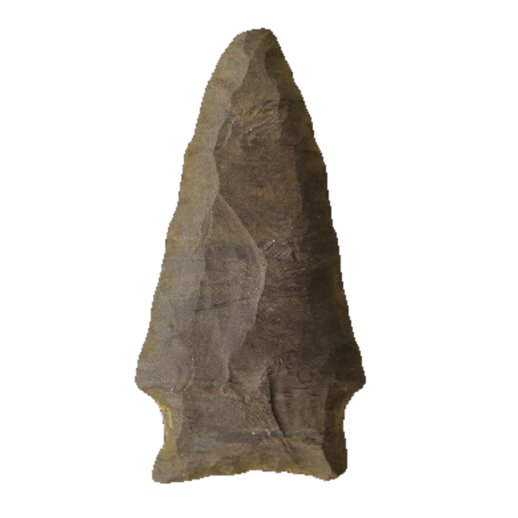
Arrowhead type
Benton Broad Stem Point
Benton Broad StemBenton Stemmed Cluster6,000 - 4,000 B.P.Middle Archaic3 reference photos
Key facts
- Age
- 6,000 - 4,000 B.P.
- Cultural period
- Middle Archaic
- Size
- Medium to Large
- Shape
- Straight Stem to Expanding Stem
- Glacial period
- Middle Holocene
More from the Archaic period
Description
This stemmed point exhibits a medium to large size profile, characterized by an elliptical or flattened cross-sectional morphology. The blade displays an excurvate shape, distinguished by a shorter and broader configuration compared to the Benton point. The shoulder morphology is marked by a narrow width, with an orientation that spans from horizontal to upwardly angled. In contrast to the Benton point, the stem is notably broader. The basal edge is typically straight, although it can exhibit a subtle convexity or concavity. Both the stem and basal edges feature steep beveling. The flaking pattern observed on this point is random, lacking a discernible order or orientation.
Size
The dimensions of the arrowheads are as follows: they range in length from 61 to 104 mm, with a mean length of 82 mm. The stem length varies between 10 and 12 mm, averaging 11 mm. The blade width spans 27 to 36 mm, with an average width of 30 mm. The stem width measures between 17 and 23 mm, averaging 19 mm. In terms of thickness, the arrowheads range from 9 to 12 mm.
Distribution
These artifacts are predominantly discovered in the Tennessee River Basin and extending into the central and southern Ohio River region
Additional information
More information needed.
Identified by
- Named by
- James Cambron and David Hulse
- Year
- 1986
Similar types
Types that are easy to confuse with the Benton Broad Stem point.
Other types in the Benton Stemmed Cluster
- Big Sandy
- Benton Blade
- Benton Bottleneck
- Benton Narrow Blade
- Benton Double Notch