
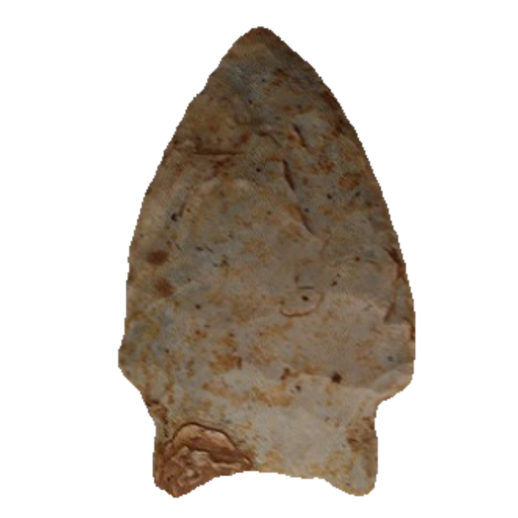
Arrowhead type
Sykes Point
SykesWhite Springs Cluster5,500 - 3,000 B.P.Late Archaic9 reference photos
Key facts
- Age
- 5,500 - 3,000 B.P.
- Cultural period
- Late Archaic
- Size
- Medium
- Shape
- Expanding Stem to Straight Stem
- Glacial period
- Middle Holocene to Neoglacial
More from the Archaic period
Description
This triangular stemmed point exhibits a distinctive elliptical profile, with a blade shape that can vary from gently curved to straight-edged. The formation of shallow notches is achieved through the strategic removal of the triangular platform's corners, resulting in shoulders that are either level or slope downward at a slight angle, devoid of barbing. The stem, characterized by its short and broad proportions, may display a range of forms, from straight to subtly expanding. The base of the point is typically straight, although occasional specimens may exhibit a concave curvature. The flaking pattern observed on these points is random and non-directional. Additionally, many examples display evidence of basal grinding and thinning, indicative of deliberate edge refinement.
Size
The dimensions of the arrowheads are as follows: they typically range in overall length from 40 to 80 mm, with an average length of 49 mm. The stem, which forms the base of the arrowhead, measures between 6 and 15 mm in length. The blade, the widest part of the arrowhead, varies in width from 22 to 49 mm, averaging 29 mm. The stem itself ranges from 15 to 35 mm in width, with the shoulder area commonly measuring between 3 to 5 mm. In terms of thickness, the arrowheads are between 6 and 13 mm, with an average thickness of 9 mm.
Distribution
This type is mainly discovered in the Tennessee River region and its surrounding drainage areas. They occur with decreasing regularity into the Ohio River basin
Also found, less often, in
Additional information
In the realm of Native American arrowhead typology, the White Springs point exhibits notable similarities to the Sykes point, yet distinct differences are evident upon closer examination. A key distinguishing feature lies in the stem morphology, where White Springs points typically display a smaller stem that is characterized by basal thinning. This characteristic is not as prevalent in Sykes points, which often possess a slightly longer stem with basal thinning occurring less frequently. As observed by MaGahey in 2000, this subtle yet significant variation highlights the importance of meticulous analysis in identifying and differentiating between these point types. By recognizing these nuances, archaeologists can gain a deeper understanding of the technological and cultural preferences of the indigenous groups that crafted these artifacts.
Identified by
- Named by
- Thomas M. N. Lewis
- Year
- 1961
- Type site
- Eva Site, Benton County, Tennessee
Similar types
Types that are easy to confuse with the Sykes point.