
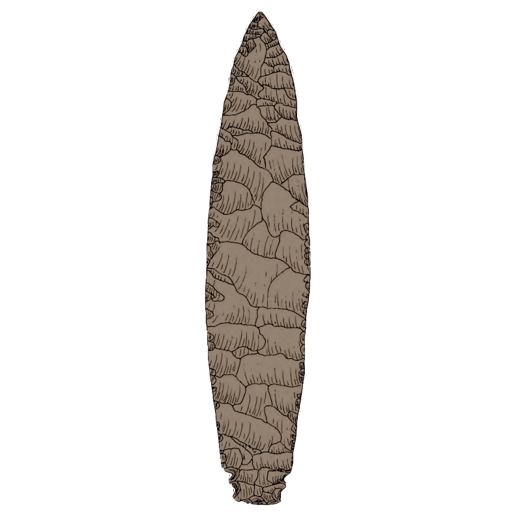
Arrowhead type
Benton Double Notch Point
Benton Double NotchBenton Stemmed Cluster6,000 - 4,000 B.P.Middle Archaic9 reference photos
Key facts
- Age
- 6,000 - 4,000 B.P.
- Cultural period
- Middle Archaic
- Size
- Medium to Large
- Shape
- Expanding Stem
- Glacial period
- Middle Holocene
More from the Archaic period
Description
This substantial projectile point exhibits a distinctive morphology, characterized by an elliptical to flattened profile and a pronounced excurvate blade. The shoulder region is marked by a horizontal orientation, with the edges bearing a double-notched configuration. The stem displays a range of forms, from straight to expanding, and is distinguished by steeply beveled edges that extend to the base. The basal edge itself is generally straight, although it may exhibit a subtle convex curvature. The overall flaking pattern appears to be random, lacking a discernible order or orientation.
Size
The arrowhead's dimensions are characterized by the following measurements: its overall length ranges from 90 to 225 mm, while the stem measures between 14 and 25 mm in length. The blade's width spans from 32 to 55 mm, and the neck width varies between 17 and 24 mm. Additionally, the stem's width is recorded to be between 18 and 26 mm.
Distribution
These artifacts are predominantly discovered in the Tennessee River Basin and extending into the central and southern Ohio River basin
Additional information
In the realm of Native American archaeology, a particular type of arrowhead has garnered significant attention. Notably, the characteristics of this artifact bear a striking resemblance to the Nettleton Double Notch, a classification established by renowned researchers Jay Johnson and Samuel Brooks in their 1949 study. This seminal work focused on examples unearthed in Arkansas, shedding light on the cultural and historical context of these ancient tools. The Nettleton Double Notch is distinguished by its unique notching pattern, a feature that has enabled archaeologists to trace the distribution and usage of this arrowhead type across various regions.
The identification of this arrowhead as potentially belonging to the Nettleton Double Notch category is grounded in the meticulous research conducted by Johnson and Brooks. Their 1949 publication laid the foundation for a deeper understanding of the technological and stylistic developments in Native American arrowhead manufacture. By examining the morphological characteristics of these artifacts, researchers can glean insights into the cultural exchange networks, hunting practices, and technological innovations of the indigenous populations that created them. The presence of Nettleton Double Notch arrowheads in Arkansas underscores the complex and dynamic nature of pre-Columbian societies in Eastern North America.
Further study of this arrowhead type is warranted to fully elucidate its significance within the broader context of Native American archaeology. The work of Johnson and Brooks serves as a testament to the importance of systematic classification and rigorous research in advancing our understanding of the past. As archaeologists continue to investigate the characteristics and distribution of the Nettleton Double Notch, they may uncover new evidence that sheds light on the lives and traditions of the people who crafted these remarkable artifacts. By building upon the foundational research of Johnson and Brooks, scholars can refine their understanding of the cultural and historical nuances that underpin the development of Native American arrowhead technology.
Identified by
- Named by
- Jay K. Johnson and Samuel O. Brookes
- Year
- 1989
Similar types
Types that are easy to confuse with the Benton Double Notch point.
- Nettleton
Other types in the Benton Stemmed Cluster
- Big Sandy
- Benton Blade
- Benton Bottleneck
- Benton Broad Stem
- Benton Narrow Blade
- Buzzard Roost Creek
- Elk River