
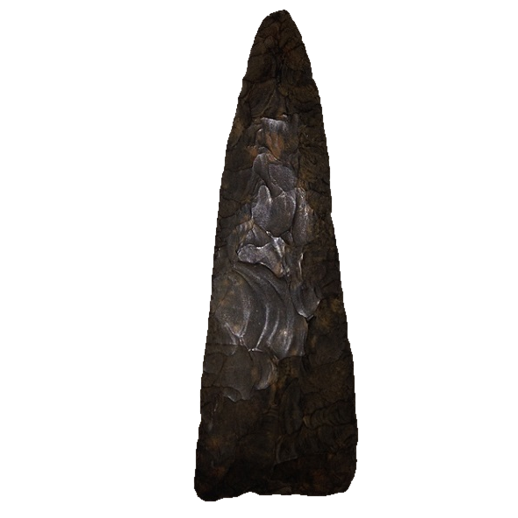
Arrowhead type
Benton Blade
Benton Blade6,000 - 4,000 B.P.Middle Archaic14 reference photos
Key facts
- Age
- 6,000 - 4,000 B.P.
- Cultural period
- Middle Archaic
- Size
- Medium to Large
- Shape
- Triangle
- Glacial period
- Middle Holocene
More from the Archaic period
Description
This triangular lanceolate point exhibits a distinctive shape, characterized by an elliptical to flattened profile. Its blade displays a pronounced excurvate curvature, while the base presents a varied morphology, ranging from a straight edge to a subtly concave outline. The flaking pattern observed on this artifact is random, lacking a discernible order or orientation.
Size
The arrowheads exhibit a range of dimensions, with overall lengths spanning from 90 to 210 mm and blade widths varying between 40 and 60 mm.
Distribution
These artifacts are predominantly discovered in the Tennessee River Basin and extending into the central and southern Ohio River region
Additional information
In the realm of Native American archaeology, a fascinating artifact has emerged, potentially signifying a preform of the esteemed Benton type. This particular specimen warrants closer examination, as it may provide valuable insights into the craftsmanship and technological prowess of the indigenous cultures that created these distinctive arrowheads. The Benton type, characterized by its unique morphology and stylistic attributes, is a significant component of the archaeological record, offering a window into the lives and traditions of the people who fashioned these tools.
Notably, the Benton type is associated with a specific cultural and temporal context, although the exact dates and locations of its origins are still the subject of ongoing research and debate. As archaeologists continue to study and analyze these artifacts, they are gaining a deeper understanding of the complex societal dynamics and technological developments that shaped the lives of Native American communities. The discovery of a potential preform, such as the one in question, is particularly noteworthy, as it may shed light on the manufacturing processes and techniques employed by these ancient craftsmen.
Further investigation and analysis of this artifact are necessary to confirm its classification as a Benton type preform and to elucidate its significance within the broader context of Native American archaeology. By examining the morphological characteristics, material composition, and other distinguishing features of this specimen, researchers can gain a more nuanced understanding of the cultural and historical factors that contributed to the development of this iconic arrowhead type. Ultimately, this research has the potential to enrich our knowledge of the technological, social, and cultural practices of Native American societies, providing a more comprehensive and detailed picture of their lives and traditions.
Identified by
- Named by
- Madeline Kneberg
- Year
- 1956
- Type site
- Eva Site, Benton County, Tennessee
Similar types
Types that are easy to confuse with the Benton Blade point.
- Copena Triangular
- Cobbs
Other types in this cluster
- Big Sandy
- Benton Bottleneck
- Benton Double Notch
- Benton
- Benton Broad Stem
- Benton Narrow Blade
- Buzzard Roost Creek
- Elk River