
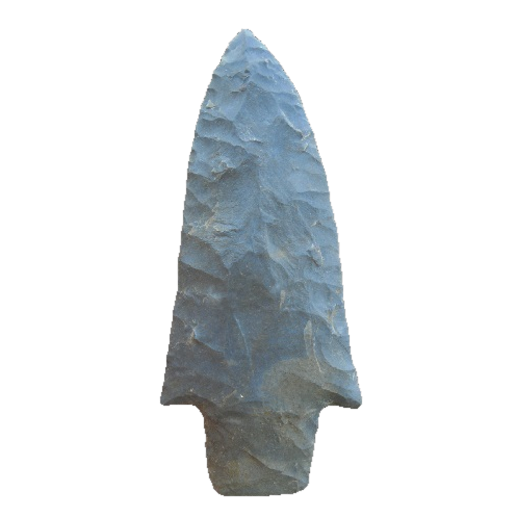
Arrowhead type
Belnap Point
BelnapDickson Contracting Stem Cluster3,000 - 2,000 B.P.Late Archaic to Early Woodland3 reference photos
Key facts
- Age
- 3,000 - 2,000 B.P.
- Cultural period
- Late Archaic to Early Woodland
- Culture
- Black Sand, Havana, and Trempealeau Hopewell Cultures
- Size
- Medium
- Shape
- Contracting Stem
- Glacial period
- Neoglacial to Roman Warm
Description
This triangular point exhibits a distinctive morphology, characterized by a medium size and a contracting stem with an elliptical profile. The blade's curvature is predominantly excurvate, while the shoulders are marked by pronounced barbs. The stem tapers to a base that is straight or slightly convex, giving it a squarish outline. The flaking pattern on this point is random, lacking a discernible order or orientation. Overall, the combination of these features yields a unique and identifiable point type.
Size
Medium
Distribution
These artifacts are predominantly discovered in Illinois, Indiana, Michigan, and extending into Wisconsin, within regions linked to the Black Sand and Havana Hopewell cultural spheres
Additional information
In the realm of Native American arrowhead typology, a particular point of interest exhibits characteristics that align with the Dickson type, albeit with some notable distinctions. One of the primary features that sets this point apart is its relatively wider stem, which deviates from the more slender stems typically associated with Dickson points. Additionally, the presence of barbed shoulders on this point is a characteristic that further differentiates it from the traditional Dickson type. For comparative purposes, it is worth noting that Dickson points generally tend to be thinner than those classified as Belknap points, highlighting the complexity and variability within these archaeological categories.
The Dickson type, characterized by its unique combination of attributes, is an important classification within the study of Native American arrowheads. The wider stem and barbed shoulders observed on this particular point contribute to a more nuanced understanding of the Dickson type and its position within the broader context of arrowhead typology. By examining these subtle variations, researchers can gain valuable insights into the technological, cultural, and historical contexts in which these points were crafted and utilized.
The comparison between Dickson and Belknap points also underscores the significance of meticulous classification and analysis in archaeology. The differences in stem width and overall thickness between these two types serve as a reminder of the importance of attention to detail in the study of archaeological artifacts. By recognizing and interpreting these subtle distinctions, scholars can reconstruct a more accurate and comprehensive picture of the lives and cultures of the Native American communities that created these arrowheads, ultimately enriching our understanding of the past.
Identified by
- Named by
- Fay-Cooper Cole and Thorne Deuel
- Year
- 1937
Similar types
Types that are easy to confuse with the Belnap point.
- Burkett
- Coahuila
- Cypress Creek
- Hidden Valley
- Langtry
- Marion
- Morrow Mountain
- New Market
- Newnan
- Waubesa