
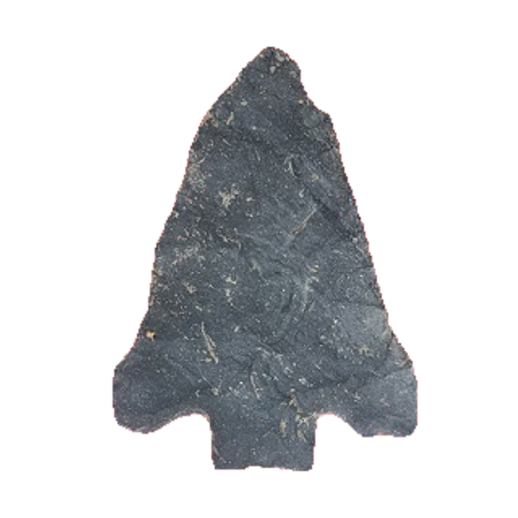
Arrowhead type
Conejo Point
Conejo3,500 - 2,300 B.P.Late Archaic3 reference photos
Key facts
- Age
- 3,500 - 2,300 B.P.
- Cultural period
- Late Archaic
- Size
- Small to Medium
- Shape
- Expanding Stem to Corner Notch to Bifurcated
- Glacial period
- Neoglacial
More from the Archaic period
Description
This medium-sized point exhibits a distinctive elliptical profile, with its overall form fluctuating between triangular and pentagonal configurations. The blade itself is characterized by an excurvate shape, often curving inward at the shoulder edge, resulting in a rounded appearance. The shoulders are typically pronounced, with strong barbing being the most common feature, although some specimens may display only slight barbing. The stem expands outward, while the base presents a variable morphology, ranging from a concave shape to a base with a shallow, central basal notch. The flaking pattern observed on this point is random, lacking a discernible, organized arrangement.
Size
The dimensions of the arrowheads are characterized by the following measurements: overall length ranges from 30 to 60 mm, while the stem length spans 10 to 15 mm. The blade width is measured between 30 to 40 mm, and the neck width falls within the range of 13 to 18 mm. Additionally, the stem width is observed to be between 16 to 24 mm, noting that these measurements are derived from a limited dataset.
Distribution
This type is mainly discovered in the southern Pecos area and extending into the Big Bend territory of Texas, Coahuila and Chihuahua. This type may occasionally appear in southeastern New Mexico.
Also found, less often, in
Additional information
More information needed.
Identified by
- Named by
- LeRoy Johnson Jr.
- Year
- 1964
- Type site
- The Devils Mount Site, Val Verde, Texas
Similar types
Types that are easy to confuse with the Conejo point.