
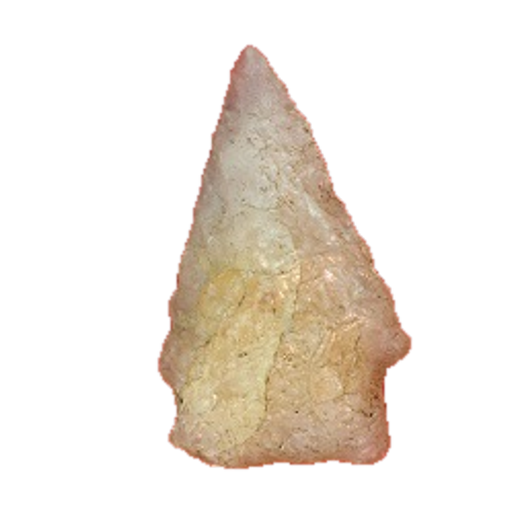
Arrowhead type
Autauga Point
Autauga9,000 - 7,000 B.P.Early Archaic3 reference photos
Key facts
- Age
- 9,000 - 7,000 B.P.
- Cultural period
- Early Archaic
- Size
- Small
- Shape
- Traingle to Expanding Stem to Corner Notch
- Glacial period
- Early to Middle Holocene
More from the Archaic period
Description
This triangular point, measuring between 0.9 and 1.5 inches in length, exhibits a distinctive morphology characterized by an elliptical to rhomboid cross-sectional profile. Its straight-edged blade often features serrations and beveling, imparting a sharp, angled cutting surface. The shoulders of the point are marked by a horizontal to upward-sloping orientation, while the stem expands outward, terminating in a base that is either straight or subtly concave. The flaking pattern observed on this point is random, lacking a discernible, organized sequence.
Size
The dimensions of the arrowheads are as follows: they typically range in length from 23 to 38 mm, with an average length of 32 mm. The stem measures between 5 and 7 mm in length, averaging 6 mm. The blade width varies from 15 to 21 mm, with a mean width of 19 mm. The neck width ranges from 13 to 18 mm, while the stem width falls between 16 and 21 mm, averaging 18 mm. In terms of thickness, the arrowheads measure between 6 and 8 mm.
Distribution
This type is mainly located in the Tennessee River region.
Mainly found in
Also found, less often, in
Additional information
The arrowhead in question belongs to a distinct variant of the Dolores type, characterized by a notable elongation of its stem. This distinguishing feature sets it apart from the Dolores Expanding Stem, with which it shares other similarities. Notably, research has linked this particular type to the High Altitude Anasazi Lithic Assemblage, a connection first proposed by Dykman in 1976. This association underscores the significance of this arrowhead variant within the context of Anasazi material culture, highlighting the importance of lithic analysis in understanding the technological and cultural practices of this ancient group.
The High Altitude Anasazi Lithic Assemblage is a significant archaeological concept, as it sheds light on the adaptive strategies and technological innovations of Anasazi communities inhabiting high-altitude regions. The inclusion of this Dolores variant within this assemblage suggests a degree of cultural and technological continuity among these communities, despite the challenges posed by their elevated environments. Further study of this arrowhead type and its associations can provide valuable insights into the lives and traditions of the Anasazi people, as well as the broader cultural and historical context of the region.
The identification of this arrowhead as part of the High Altitude Anasazi Lithic Assemblage also underscores the importance of careful typological analysis in archaeology. By recognizing the distinctive characteristics of this variant, researchers can reconstruct the technological, social, and cultural dynamics of past societies, ultimately enriching our understanding of Native American history and culture. As such, this Dolores variant serves as a significant artifact, offering a window into the lives and traditions of the Anasazi people and highlighting the value of continued research into the archaeology of the region.
Identified by
- Named by
- James Cambron and David Hulse
- Year
- 1975
Similar types
Types that are easy to confuse with the Autauga point.
Other types in this cluster
- Decatur
- Big Sandy
- Crawford Creek