
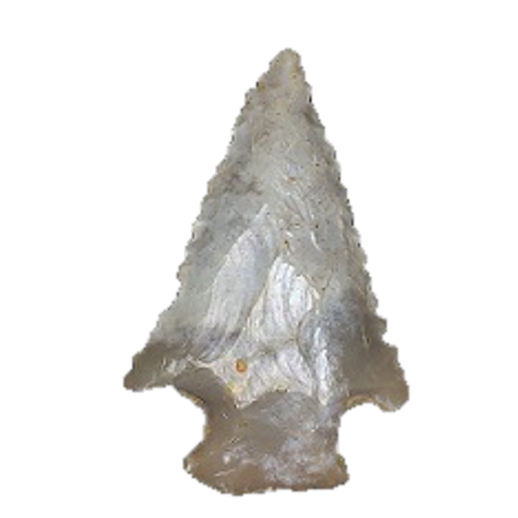
Arrowhead type
Crawford Creek Point
Crawford CreekWhite Springs Cluster8,000 - 7,000 B.P.Early Archaic2 reference photos
Key facts
- Age
- 8,000 - 7,000 B.P.
- Cultural period
- Early Archaic
- Size
- Small to Medium
- Shape
- Expanding Stem to Straight Stem to Corner Notch
- Material
- Flint
- Glacial period
- Middle Holocene
More from the Archaic period
Description
This point exhibits a distinctive morphology, characterized by a compact to moderately sized profile, typically ranging from 1 to 1.75 inches in length. Its cross-sectional shape is elliptical, providing a sturdy foundation for the blade. The blade itself is generally straight, although some specimens may display a subtle excurvate curvature. A notable feature of this point is the presence of fine serrations along the blade edge. The shoulders of the point can vary in orientation, ranging from a slight upward angle to a more pronounced barbed configuration. The stem is typically expanding, but occasional examples may feature a straight stem. The basal edge is usually straight, but can exhibit a slight convexity or concavity. Many specimens display basal thinning, a technique used to refine the point's base. The flaking pattern on this point is characterized by a random arrangement of flakes, lacking a discernible pattern or orientation.
Size
The arrowheads exhibit the following dimensional characteristics: overall length ranges from 27 to 46 mm, with a mean length of 36 mm. The stem length varies between 6 and 9 mm, averaging 8 mm. The blade width measures between 20 and 30 mm, with an average width of 25 mm. The stem width ranges from 13 to 20 mm, averaging 16 mm. In terms of thickness, the arrowheads measure between 5 and 7 mm.
Distribution
This type is mainly discovered throughout the Tennessee River Basin and extending into middle Tennessee.
Also found, less often, in
Additional information
In his 1964 study, Cambron observed a notable variation in the morphology of certain arrowhead specimens. Specifically, he found that while some examples featured a straight stem, the majority of older specimens exhibited expanding stems. This distinction suggests a potential chronological trend, with the expanding stem design appearing to predate the straight stem configuration. This observation highlights the importance of considering stem morphology as a diagnostic criterion in the analysis and dating of arrowhead artifacts. By examining the shape and form of the stem, researchers can gain valuable insights into the evolutionary development of arrowhead technology and the cultural practices of the societies that created them.
Identified by
- Named by
- David DeJannette
- Year
- 1962
- Type site
- Flint Creek Rock Shelter, Morgan County, Alabama
Similar types
Types that are easy to confuse with the Crawford Creek point.
- Brewerton
- Coosa
- Culpeper
- Kanawha
- Kirk Corner Notch
- Merom
- Mud Creek