
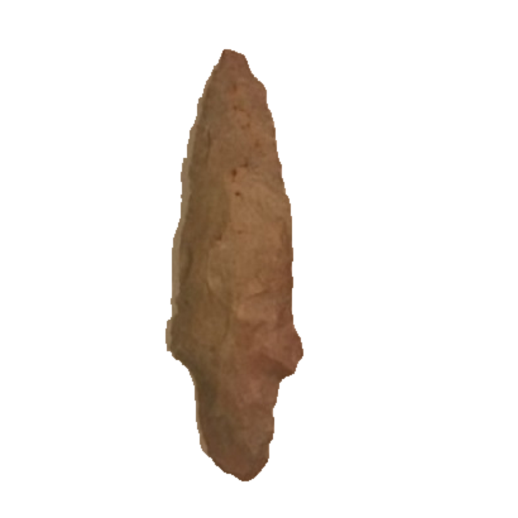
Arrowhead type
Adena Narrow Blade
Adena Narrow BladeAdena Cluster3,500 - 1,300 B.P.Late Archaic to Woodland4 reference photos
Key facts
- Age
- 3,500 - 1,300 B.P.
- Cultural period
- Late Archaic to Woodland
- Culture
- Adena culture
- Size
- Medium to Large
- Shape
- Straight Stem
- Material
- Jasper
- Glacial period
- Neoglacial to Roman Warm
Description
This triangular stemmed point exhibits a medium to large size profile, characterized by an elliptical cross-sectional shape. The blade morphology is typically excurvate, although variations can occur, resulting in a straight-edged form. The shoulder edges display a range of curvature, from straight to rounded, while the shoulders themselves may be straight or slightly barbed. The stem is generally straight, with some instances showing a slight contraction. The basal edge is typically convex, but can occasionally appear straight. The flaking pattern on this point is random, lacking a consistent or organized arrangement.
Size
The dimensions of the arrowheads are as follows: overall length ranges from 45 mm to 110 mm, while the stem measures between 12 mm and 20 mm in length. The width at the shoulders varies from 25 mm to 50 mm, and the stem width ranges from 10 mm to 20 mm. In terms of thickness, the average measurement is 9 mm.
Distribution
These artifacts are located within the Ohio River Valley region. The typical dispersion of the Adena points is highlighted in red (see Additional Comments). The yellow area represents the sphere of influence and exchange of the Mound Builders, encompassing the Adena, Hopewell, and Mississippian Cultures.
Mainly found in
Also found, less often, in
Additional information
The Adena Culture is widely regarded as the inaugural Mound Builder Culture, paving the way for subsequent cultures such as the Hopewell and Mississippian. Characteristic Adena points, primarily discovered in the Ohio River Valley, exhibit distinctive features that set them apart from other projectile points. However, similar points can be found within the broader Mound Builder Distribution, including the Waubesa point associated with the Hopewell Culture, as well as the Dickson, Mason, and Florence points linked to the Red Ocher Culture. When encountering Adena-style points outside their traditional cultural area, it is essential to consider the possibility that they may be analogous types.
Notably, early Adena points appear to have originated in the Tennessee River Valley, with Kneberg's 1956 research suggesting that they spread from this region during the early Woodland period. Nevertheless, the Adena culture is believed to have centered in and originated from the Ohio River Valley. A comparative analysis of Adena and Waubesa points reveals significant overlap in their characteristics. A key distinguishing feature of Adena points is the less defined shoulder area, with the blade's widest section located above the shoulders. In contrast, Waubesa points, as observed by Morrow in 2016, are marked by well-defined shoulders, where the blade's widest part is situated at the shoulder level. This subtle yet significant difference highlights the importance of meticulous examination when identifying and categorizing these ancient projectile points.
The similarities and differences between Adena and Waubesa points underscore the complexities of the Mound Builder Cultures and their associated material cultures. As archaeologists continue to study and refine our understanding of these cultures, the nuances of their projectile points remain a vital area of research. By examining the distribution, characteristics, and evolution of these points, we can gain a deeper insight into the lives and traditions of the Adena and other Mound Builder cultures, ultimately enriching our comprehension of North America's rich and diverse cultural heritage.
Identified by
- Named by
- James Cambron
- Year
- 1964
Similar types
Types that are easy to confuse with the Adena Narrow Blade point.
- Boggy Branch Type II
- Burkett
- Cypress Stemmed
- Duncan Island
- Elk River
- Kent
- Koens Crispin
- Kramer
- Hamilton Stemmed
- Hidden Valley
- Lehigh
- Macon
- New Market
- Pontchartrain
- Randolph
Other types in the Adena Cluster
- Adena Dickson
- Gary
- Little Bear Creek
- Poplar Island
- Rossville