
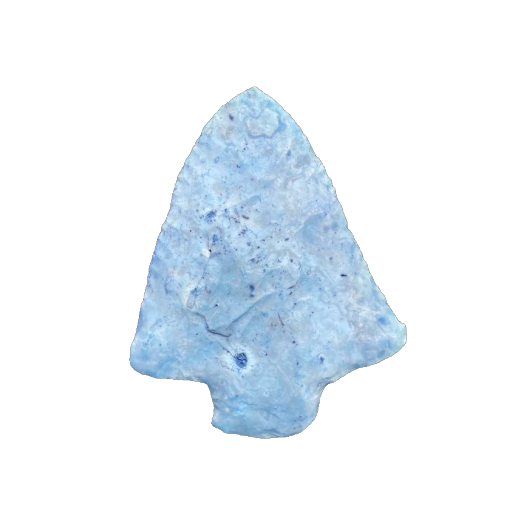
Arrowhead type
Abbie Point
AbbieAbbie Cluster5,000 - 4,000 B.P.Early Archaic10 reference photos
Key facts
- Age
- 5,000 - 4,000 B.P.
- Cultural period
- Early Archaic
- Size
- Medium to Large
- Shape
- Expanding Stem to Straight Stem
- Material
- Steel
- Glacial period
- Middle Holocene
More from the Archaic period
Description
This triangular stemmed point exhibits a width range of 1.5 to 2.75 inches, characterized by a predominantly flattened or hexagonal cross-sectional profile, although occasional specimens may display an elliptical cross section. The blade morphology varies, spanning straight, incurvate, and recurvate forms, often marked by a curved tip and a shoulder that flares outward. Extensive re-working of the blade is common, resulting in steeply angled bevels along all edges and the presence of fine serrations. The shoulders frequently exhibit asymmetry, ranging from subtly barbed to slightly angled upward. The stem's orientation can be straight or slightly expanding, while the base ranges from straight to mildly convex, often thinned to a notable degree. The flaking pattern observed on this point is random, lacking a discernible, organized arrangement.
Size
The dimensions of these arrowheads are characterized by the following measurements: - Length ranges from 38 to 80 mm, with a typical average length of 42 to 52 mm. - The stem length varies between 8 to 14 mm, averaging between 10 to 11 mm. - The width of the blade spans 32 to 61 mm, with an average width of 40 to 50 mm. - The stem width is measured between 12 to 23 mm, averaging 17 to 20 mm. - The thickness of the arrowheads falls within the range of 7 to 12 mm.
Distribution
This type is mainly discovered in the seaside lowlands of Georgia, Alabama, and the northernmost part of Florida. Sightings extend into inland Georgia and Alabama, but occur less often.
Also found, less often, in
Additional information
In the realm of Native American arrowheads, the Abbey point is a notable type that exhibits characteristics from both the Benton and Pickwick clusters. A distinctive feature of the Abbey point is its frequent discovery in a heavily re-sharpened or completely spent state, suggesting extensive use and reuse by its original creators. This observation has led some researchers, including Gregory Perino, to propose that the Abbey point may, in fact, represent a worn-down Maples point, which has undergone significant re-sharpening, resulting in a shorter blade (W11).
The Cottonbridge type is another variant that shares many characteristics with the Abbey point and exhibits a similar distribution pattern. However, the Cottonbridge type can be distinguished from its Abbey counterpart by its straight to excurvate blade shape and convex to rounded basal edge, whereas the Abbey type typically features a recurvate blade and a straight basal edge (Granger and Granger, 2013). This subtle distinction highlights the complexity and diversity of Native American arrowhead types, which often blur the lines between distinct categories.
The Abbey point's naming origins are also noteworthy, as it was first identified by Ralph Allen, who submitted several examples to David Hulse for publication. These initial specimens were recovered from Abbie Creek in Alabama, but unfortunately, Hulse misspelled the creek's name, resulting in the point being referred to as the "Abbey" point. Despite suggestions to revert to the original "Abbie" naming, the term "Abbey" has persisted in the archaeological community, serving as a testament to the complexities and nuances of cultural and historical record-keeping.
Identified by
- Named by
- David Hulse and Ralph Allen
- Year
- 1964
- Type site
- Multiple sites in around Abbie Creek, Henry County, Alabama.
Similar types
Types that are easy to confuse with the Abbie point.
- Alachua
- Benton
- Cottonbridge
- Elora
- Levy
- Maples
- Notchaway
- Pickwick
- Savannah River
- Six Mile Creek
- South Prong Creek
- Wacissa