
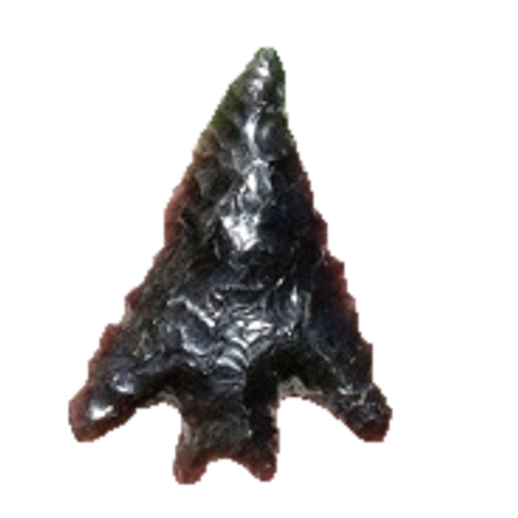
Arrowhead type
Gatecliff Split Stem Point
Gatecliff Split StemPinto Cluster5,000 - 3,000 B.P.Middle Archaic to Late Archaic2 reference photos
Key facts
- Age
- 5,000 - 3,000 B.P.
- Cultural period
- Middle Archaic to Late Archaic
- Size
- Medium
- Shape
- Straight Stem to Expanding Stem to Bifurcated
- Glacial period
- Middle Holocene to Neoglacial
More from the Archaic period
Description
This triangular-pointed artifact exhibits a distinctive morphology, characterized by a slender, medium-sized blade with a cross-sectional profile that ranges from flattened to elliptical. The dorsal edge of the blade typically displays an excurvate curvature, although some specimens may exhibit a straighter profile. Serrations are a common feature along the blade's edge. The shoulders of the point can vary in their orientation, spanning from subtly barbed to more pronouncedly angled upwards. The stem, which is generally straight, may exhibit a slight contraction or expansion. A notable characteristic of the base is its concave shape, giving rise to a bifurcated stem. The flaking pattern on this point can be highly variable, ranging from an irregular, random arrangement to a more organized, parallel-oblique pattern.
Size
The dimensions of the arrowheads are as follows: they exhibit a total length ranging from 34 to 53 mm, with a mean length of 42 mm. The stem length varies between 6 and 19 mm. In terms of width, the blade measures between 18 and 27 mm, averaging 24 mm, while the stem width ranges from 11 to 26 mm. The thickness of the arrowheads falls within a range of 5 to 9 mm.
Distribution
This type is mainly discovered throughout the Great Basin region, stretching eastwards to the Colorado River, and then southwards along the Colorado River to California
Additional information
In the realm of Native American arrowhead typology, the Gatecliff Split Stem and Elko Eared points have been the subject of extensive study and debate. According to Justice (2002), the Gatecliff Split Stem predates the Elko Eared, yet they appear to represent a continuous technological development. This suggests that the two types may not be distinct, but rather part of a gradual evolution in point design. Some researchers have proposed that certain points may occupy an intermediate position between the Gatecliff Split Stem and Elko Eared types, or that they may simply represent variations within these established categories.
A key factor in distinguishing between the Gatecliff Split Stem and Elko Split Stem points is the morphology of their basal terminations. Landon (2005) noted that Gatecliff Split Stem points are characterized by straight stems and sharp basal terminations, whereas Elko Split Stem points exhibit rounded basal terminations. This distinction has significant implications for the classification and understanding of these point types. Furthermore, the work of James O'Connell (1971) highlights the complexity of point typology in the region. Initially, O'Connell identified a type known as Bare Creek, based on examples from the King's Dog and Rodriguez sites in California's Surprise Valley. However, upon re-examining the projectile points from Surprise Valley in 1994, O'Connell reclassified all points as Gatecliff, without mentioning the Bare Creek or Surprise Split Stem types. Notably, the Surprise Valley points were distinguished by the presence of barbed shoulders, a characteristic that sets them apart from other point types.
The study of Native American arrowheads, such as the Gatecliff Split Stem and Elko Eared points, offers valuable insights into the technological and cultural developments of prehistoric societies. By examining the morphological characteristics and distribution of these points, researchers can reconstruct the lives and traditions of ancient cultures. The Gatecliff Split Stem point, in particular, is notable for its straight stem and sharp basal terminations, which distinguish it from other point types. As our understanding of these points continues to evolve, it is essential to consider the complexities and nuances of point typology, as well as the cultural and historical contexts in which they were created.
Identified by
- Year
- 1981
- Type site
- Gatecliff Shelter, Nevada.
Similar types
Types that are easy to confuse with the Gatecliff Split Stem point.
- Elko Split Stem
- Pinto
- Rabbit Island
- Vandenberg
Other types in the Pinto Cluster
- Gatecliff