
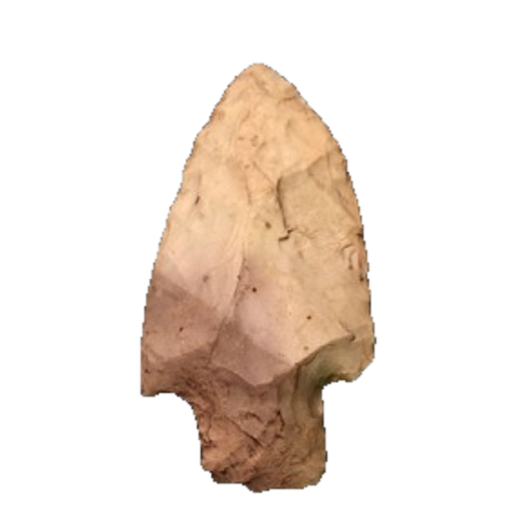
Arrowhead type
Stone Square Point
Stone SquareEtley Cluster6,000 - 4,000 B.P.Middle Archaic15 reference photos
Key facts
- Age
- 6,000 - 4,000 B.P.
- Cultural period
- Middle Archaic
- Size
- Medium to Large
- Shape
- Straight Stem
- Glacial period
- Middle Holocene
More from the Archaic period
Description
This triangular stemmed point exhibits a size range from medium to large, characterized by a cross-sectional profile that transitions from flattened to elliptical. The blade's curvature varies, spanning from an excurvate to an outwardly recurvate form. The shoulders display a range of expression, from subtle to pronounced, and may be oriented horizontally or exhibit a slight barbing. The stem is distinguished by its straight alignment, accompanied by a basal edge that is either straight or subtly convex. The flaking pattern observed on this point is random, lacking a discernible order or sequence.
Size
The dimensions of the arrowheads are characterized by the following measurements: overall length ranges from 50 to 120 mm, with a typical average length of 65 to 75 mm. The stem length is between 10 to 16 mm. The blade width varies from 24 to 40 mm, averaging 30 to 35 mm. At the shoulders, the stem width is measured to be between 15 to 20 mm. The thickness of the arrowheads falls within the range of 7 to 10 mm.
Distribution
This type exhibits the greatest abundance in the southern Ohio River basin and extends into the central Mississippi River basin. This type may share a similar geographic range to the Smith point (see additional comments)
Mainly found in
Additional information
In a notable study, Marshall identified two distinct point types, namely the Stone Square Stem and the Barry Square Stem, although the latter designation is seldom utilized. A compelling argument has been put forth suggesting that these points are, in fact, variants of the Smith type, which have undergone various degrees of re-sharpening. This process of re-sharpening can be so extensive that it ultimately results in the obliteration of the point's shoulders, leading to a modified morphology. Interestingly, archaeological findings have shown that these re-sharpened points often co-occur with typical Smith points, as observed by Ray in 2010. This association highlights the complex and dynamic nature of point typology, underscoring the need for careful consideration of the re-sharpening process in the classification and interpretation of these artifacts.
The re-sharpening of Smith points to the point of shoulder obliteration is a significant phenomenon, as it reflects the resourcefulness and adaptability of the cultures that utilized these points. By re-sharpening and reusing their tools, these ancient societies were able to extend the functional lifespan of their points, thereby minimizing waste and optimizing resource utilization. This behavior is a testament to the ingenuity and practicality of Native American cultures, who developed sophisticated strategies for tool maintenance and reuse.
The presence of these re-sharpened points in association with typical Smith points also has implications for our understanding of the technological and cultural contexts in which they were used. By examining the co-occurrence of these points, researchers can gain valuable insights into the social, economic, and environmental factors that influenced the development and use of these tools. As such, the study of re-sharpened points, including the Stone Square Stem and Barry Square Stem, offers a unique window into the lives and practices of Native American communities, highlighting the complex interplay between technology, culture, and environment.
Identified by
- Named by
- Richard A. Marshall
- Year
- 1958
- Type site
- Table Rock Reservoir, Missouri
Similar types
Types that are easy to confuse with the Stone Square point.
- Adena
- Adena Narrow Stem
- Burkett
- Heavy Duty
- Johnson
- Kramer
- Rochester