
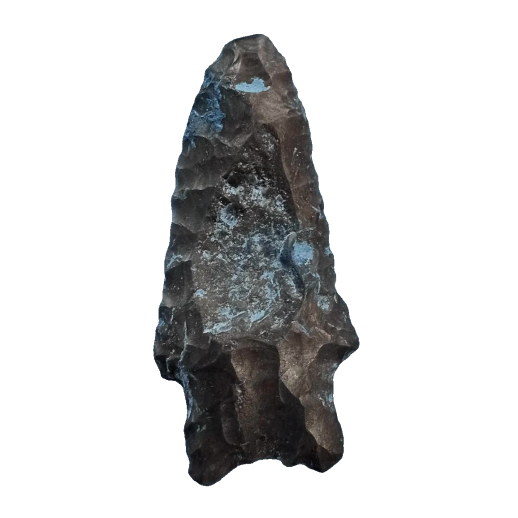
Arrowhead type
Heavy Duty Point
Heavy DutyKirk Stemmed Cluster9,000 - 7,500 B.P.Early Archaic17 reference photos
Key facts
- Age
- 9,000 - 7,500 B.P.
- Cultural period
- Early Archaic
- Size
- Medium to Large
- Shape
- Expanding Stem to Bifurcated
- Material
- Rhyolite
- Glacial period
- Early to Middle Holocene
More from the Archaic period
Description
This stemmed point exhibits a robust profile, with a size range spanning medium to large dimensions. In cross-section, its shape can fluctuate between an elliptical outline and one featuring a pronounced median ridge. The blade's curvature is predominantly excurvate, although it may display a straight or recurvate profile in specimens that have undergone re-sharpening. The shoulders of the point can exhibit a range of orientations, from a horizontal alignment to a gentle upward incline. The stem's morphology varies from straight to slightly flared, while the base is often characterized by a concave curvature. Evidence of grinding is frequently observed on the hafting area and, in cases where the base is straight, also on the base itself. The flaking pattern on this point is notable for its random, non-patterned arrangement.
Size
The dimensions of the arrowheads are as follows: they typically range in overall length from 45 to 120 mm, with a mean length of 65 mm. The stem section measures between 8 and 13 mm in length, averaging 11 mm. The blade itself spans a width of 24 to 36 mm, with an average width of 30 mm. The stem width ranges from 15 to 20 mm, averaging 17 mm. In terms of thickness, the arrowheads measure between 10 and 15 mm.
Distribution
This type is mainly linked to the Atlantic Coast area of the United States, extending into the Gulf Coast area and the Tennessee River and Ohio River valleys. This type is also found in the Mississippi River Valley and the Northeastern United States, but with less regularity
Mainly found in
Also found, less often, in
Additional information
The classification of Native American arrowheads has undergone significant refinement over the years, particularly with regards to the Heavy Duty Serrated type. Initially, Elder's 1970 study introduced this type as a distinct category, sparking further investigation into its characteristics. Robert Converse's 1973 research built upon this foundation, providing a more detailed analysis of the Heavy Duty Serrated type. However, subsequent studies, such as Justice's 1987 examination, proposed an alternative perspective, suggesting that this type might be a variant of the Kirk Stemmed point, rather than a standalone category.
Justice's hypothesis positioned the Heavy Duty Serrated type as a morphological correlate within the Kirk Stemmed cluster, implying a closer relationship between the two types than previously thought. Further research has since corroborated this idea, leading to the current understanding that the Heavy Duty Serrated type is, in fact, a characteristic subset of the Kirk Stemmed type, rather than a unique or variant type. This conclusion is supported by the absence of any archaeological site where the Heavy Duty Serrated type is the predominant point found, reinforcing the notion that it is an integral part of the Kirk Stemmed point category.
The reevaluation of the Heavy Duty Serrated type highlights the complexities and nuances of Native American arrowhead classification, demonstrating the importance of ongoing research and collaboration in refining our understanding of these artifacts. By recognizing the Heavy Duty Serrated type as a characteristic of the Kirk Stemmed point, researchers can better contextualize and interpret the archaeological record, ultimately gaining a deeper insight into the cultural and technological practices of the Native American communities that created these artifacts. This, in turn, underscores the value of continued scholarly inquiry and the need for a comprehensive and accurate understanding of the rich cultural heritage embodied in these ancient artifacts.
Identified by
- Named by
- Robert Converse and Robert Elder
- Year
- 1970
Similar types
Types that are easy to confuse with the Heavy Duty point.
- Genesee
- Harpeth River
- Stone Square Stem
Other types in the Kirk Stemmed Cluster
- Kirk Corner Notch
- Kirk Snapped Base
- St. Helena
- Tangipahoa